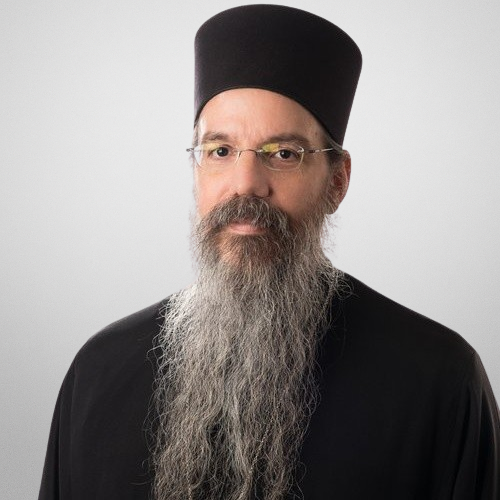
The Jesus Prayer: Meaning & Practice
Use a short, repeatable formula—'Lord Jesus Christ, have mercy on me'—starting aloud, then mentally, and allow the prayer to descend into the heart. Fr. Maximos Constas draws on the Fathers (notably St. Nicodemus and the Philokalia) and baptismal theology to explain how the practice cultivates the Holy Spirit's seed at the heart. Practically: start modestly, expect distraction, and seek a spiritual guide.
Note: This article is an automatically generated transcript of an audio lecture. It was transcribed and lightly reworded for readability using automated tools, so it does not reproduce the speaker’s exact words. For the original, listen to the recording linked below.
Listen to the original lecture on Patristic Nectar →
Key takeaways:
- The Jesus Prayer is a short repeatable formula that descends into the heart
- Begin aloud, move to mental repetition, then to heart-centered interior prayer
- Distraction and dark thoughts are normal; gently return attention without shame
- Baptism plants a seed of the Holy Spirit in the heart that must be cultivated
- Interior prayer deepens love for others rather than fostering selfishness
What the Jesus Prayer is
And in case there's somebody here who doesn't know what the Jesus Prayer is, I think it's good to just start with the definition. And again, as I'm sure all of you know, the Jesus Prayer is a very short prayer. It's probably the most beloved prayer in the Orthodox Church, and there are variations to it. But essentially, it is "Lord Jesus Christ, Son of God, have mercy on me." And some people say "have mercy on me, a sinner" or "have mercy on me, the sinner." In my experience on Mount Athos, people tend to prefer a shorter version of the prayer: Lord Jesus Christ, have mercy on me. Lord Jesus Christ, have mercy on me. There are even shorter versions of the prayer, but we won't mention those at this point. As I said, so from the shorter versions to the longer versions. And the longer versions can include Lord Jesus Christ, Son of God, have mercy on me, the sinner, through the prayers of the Theotokos and on and on.
I find that to be a little too much, because the whole idea of the prayer is to provide the one praying with a short, succinct kind of formula or phrase that one can really concentrate on. And if the prayer is long, it becomes difficult. You get lost in the details and that sort of thing. So that's the Jesus Prayer. Lord Jesus Christ, have mercy on me. Or Lord Jesus Christ, have mercy on me, the sinner. And the idea is to repeat the prayer as often as one can or as much as one can. And we'll talk more about this later, but beginners are taught to start to say the prayer verbally or orally so that the Jesus Prayer is initially a prayer of the lips. That one simply says the prayer out loud in a soft kind of a gentle tone. But the words are said, Lord Jesus Christ, have mercy on me, Lord Jesus Christ, have mercy on me, and so on. But anyone who does that, even for a few minutes, quickly realizes that this is getting tiring to keep repeating a formula over and over and over again. And what happens, I think, very naturally, very spontaneously, without any kind of effort of any kind, is that what began as a prayer of the lips, quickly, I mean, an exterior kind of a prayer, very quickly, very naturally becomes a kind of an interior prayer.
And it goes from being a prayer of the lips to being a prayer of the mind. It's something that one says internally or mentally, let's say. And then after much practice and with the grace of God, the prayer begins to descend or enter into oneself much more deeply so that it goes from not simply being a mental thing, something you're saying, like you could recite, I don't know, the Declaration, not the Declaration of Independence, but that's what I meant to say. There are certain texts that we've memorized that we can recite in our minds. But there's a deeper level than that, too. And that's what we would call the level of the heart. And when the prayer has taken up residence, let's say, at that deeper place within the self, well, then very different things start to happen. So that's just a very quick definition of the Jesus Prayer, in case there's someone who didn't know that.
The heart and the teaching of St. Nicodemus
Let's just say a few words about the heart now, because the Jesus Prayer is also called the prayer of the heart. It's also called the prayer of the mind. In Greek, it's intellect, actually. We'll put that aside for now and focus on the idea of the Jesus Prayer as a prayer of the heart. And if anybody wants to read more about this, the best thing to read is the 10th chapter in a book by St. Nicodemus of Mount Athos. St. Nicodemus was an 18th-century Athonite monk who was a tremendously important figure in the history of the church at that time and continues to be so. He was very prolific. He wrote all kinds of things, published lots of works. He has a book that's available in English.
It's called A Handbook of Spiritual Counsel. It's available in an English translation. And the 10th chapter of that book is on the heart and the mind. And it's probably one of the best things ever written on that subject. Why? Because St. Nicodemus wrote this book when? After he had completed work on compiling the Philokalia. He had not merely compiled the Philokalia. He had lived the philokalic life as a monk on the Holy Mountain for many years, practiced the Jesus Prayer, and absorbed its theology and traditions. That was when he wrote this 10th chapter, which is a kind of a summary or a synthesis of the church's teaching on the Jesus Prayer. And some of what I'm saying is coming from there, but there's a lot more there than I can cover today. So let's talk about the heart and the understanding of the heart in the Orthodox Church. I think in secular society, although this is changing a little bit too, there's the idea that, well, the heart is just some sort of a pump. It's just some sort of a muscle that's there. It's beating away and it's powering the circulatory system. And all the real stuff that goes on is in the mind. We're very much a mind- or brain-oriented society. We place a lot of emphasis on education, let's say.
We have IQ tests, intelligence. And we try to cultivate people's intellects, but we do very little as a society in terms of cultivating people's emotions. We're good about facts and information and data, but we do very little, we have very little, to cultivate people and to grow them in a sense in terms of their deeper life, their inner life, which, again, in popular culture we refer to as sort of emotions, and it goes much deeper than that, actually. But you see that the stress is not on things like feelings or emotions or deeper aspects of inner life. It's all the stress is on the brain or on the mind. And it's funny because other cultures thought about these things very differently. If you look back to ancient Egyptian culture, when the Egyptians mummified the bodies of the dead, they would actually, the heart would be taken out and preserved very carefully.
And in the iconography in the Egyptian tombs, you would see that the heart is placed on a scale, and on one side is the heart, and on the other side is the feather of truth. And if the heart outweighs the feather of truth, well, then the person goes into the underworld to some bad place. So even the Egyptians had this sense that the heart was really the core of the person, and it was the heart that was judged in the afterlife. As far as the brain goes, I'm not sure they knew what to do with that. I mean, I think the brain they just pulled out and threw away. So they didn't have the same interest in. So not all cultures think the same way about the whole relationship between mind and brain and body or mind and heart and these kinds of things.
The heart as the center of the person
But the heart for us, the heart for us is really the center of the human person. In the scriptural, biblical, and Orthodox tradition, the center of the human person is not so much the brain or the mind as the heart. The heart is understood to be more than simply an organ functioning in the chest. And modern science actually throws very interesting light on this idea. So, for example, I was very surprised when I first learned that cardiac cells within an embryo, right, when do cardiac cells, cardiac cells are these little cells that will eventually grow to become the whole heart. And because the heart is what they call auto-rhythmic, every single cell of the heart actually beats. It's not as if you have all of these cells, these muscle tissues, that are somehow being made to beat by some external force.
It's actually every single cell, every cardiac cell, every single cell of the heart pulsates, beats, and all of those cells together form the heart and they all beat according to the same kind of rhythm. So how many days after conception are there beating cardiac cells in the embryo? Does anybody know? We might have heart doctors here or embryologists. Not immediately, not 40, not 7. No, I think it's between the second and I think by the third week after conception, which is, you know, 21, 28 days, something like that. By the third week, I don't even, can you see with the naked eye what's in a woman's womb only two or three weeks after conception? I don't think so. It's barely visible to the human eye.
And yet, there are already beating cardiac cells in that life that's in the mother's womb at that point. And the other thing too is that, the other extraordinary thing about cardiac cells is that they don't reproduce, which means that if you live to be 100 years old or 110 years old, those cardiac cells that began to beat during that second or third week of life, those cells, the same exact cells will continue to beat until the day you die. To me, that's just extraordinary. I mean, the human body is just the most amazing thing in the universe as far as we know so far. So the brain, on the other hand, right, there's no brain on the second or the third week. And even at nine months, even when the child is born, the brain is not fully developed. So we have beating cardiac cells, and we have the heart, which is there as the kind of living core of the person.
You can almost imagine it as a kind of seed out of which the rest of the person sort of grows, arms, legs, heads, everything else. But the neurological system and the brain and all of that, this is formed much, much later. In fact, even when a baby is born, its brain isn't fully developed yet. Which is why they say that the human being is the only creature, the only animal in a sense, that for whom, in other words, when you see these documentaries on television and there's like the baby cow or the baby horse that's born, and the mother gives birth to the animal in the field or whatever it is, and right away the animal just kind of shakes itself off and, you know, finds its footing. And the next thing you know, it's running around the corral or whatever it is, the field, okay? Not so with human infants. Mother gives birth to the baby.
Baby's totally helpless. Baby can't move. Baby can't see. Baby can't. Baby's not done yet. It's almost like we're born prematurely compared to animals, obviously. And some animals have longer gestation periods. So this is why they say, and this is interesting. That the human being is the only animal for whom the world is his womb. Because we think we understand, you know, how important that relationship of the embryo is to the mother's body and that whole kind of prenatal sort of experience. But that doesn't end. I mean, the womb does not — I mean, you're still in a — the womb now opens up and it's the whole world, which of course is why there's nature and then there's nurture. I mean, nurture is so important for the human person. Anyway, the point I'm making here is about the centrality of the heart and the significance of the heart and the priority of the heart. And there's a sense in which the heart chronologically precedes the brain before — I mean, you have a heart, you have — even on a kind of physiological level, you have raw animal responses to things as an organism long before you have a brain.
The baby feels, the baby senses, baby knows, baby — right? There's a whole rich world of experience and feeling that's there before there's even a brain or a mind. This is why we say that the heart is essentially the natural center of the person. And the heart is not simply — the physiological information I've been sharing with you is, in a sense, an image, an analogy, a metaphor for a much deeper situation. So if the heart is physically prior, or physically first, let's say, that suggests there's a kind of spiritual reality that that heart symbol points to. You think the heart is the core of the thing, and that's the — but even that's an external image for something much deeper.
Learning to listen to the heart
So this is what the church believes about the human person, and so much of contemporary science confirms that. And this justifies in a sense or validates what we've always said about the centrality of the heart and about the importance of the heart in the life of the human person. By the way, there are a lot of psychologists today who say things — they talk about sort of like your gut knowledge, which in a sense is sort of your heart knowledge. And they say we know stuff with our guts long before we know it with our minds. But from a young age, we're taught not to trust our guts. We're taught not to trust our feelings. Like sometimes I go into a supermarket and there's a woman with a baby or a child, and the child will say, oh, mommy, look at that man's funny beard. That's a natural, spontaneous, true observation the child is making. But then what does the mother say? Oh, don't talk like that. Don't say that. That's rude. Or I've seen it too, oh, mommy, look at the fat man. No, no, we don't say that. We don't make true observations about — Right? And these are very simple examples. Think about much more complicated sort of psychological observations that children make.
And at an early age, they learn very quickly not to vocalize those things, and to begin to even lie about certain things. Oh, someone says, well, how do I look, or how does mommy look, or how does daddy look? And by now, the child knows, well, there are right and wrong answers here. So what happens is that from a very early age, we begin to disassociate. We begin to become disconnected from that deeper source of immediate truth that we have within ourselves, and we end up now thinking through things, and we get lost on this very different plane of thought and calculation. And, of course, it's not just pure thought. The thought itself is conditioned by fears and traumas and all kinds of things that are in our minds.
And we're asked certain questions about — I mean, life poses questions to us. What should I do? And I think — and you know the answer. You know the answer is inside of you. But you're so disconnected from that, and you think, and you think, and you think, and sometimes you make the wrong decision, and then you realize — or how many times has it happened to you that you were confronted with a question, and you kind of knew what the answer was, but you didn't trust yourself? Your heart — in our popular language, your heart said one thing, but your head said something else.
The heart, the mind, and our thoughts
And you didn't trust your heart. You didn't trust your guts. You didn't go with your instinct. You thought it out, and then you realized later on that you made a huge mistake. And you say, gosh, why didn't I listen to myself? I mean, hasn't that happened to everybody? Why didn't I — right? So there is this kind of split that takes place between the heart and the mind, and it happens at a very early age. And again, part of the Orthodox tradition, our prayer practice, is that when we say the Jesus Prayer, we try to descend with the mind into the heart, and from that place of greater integration and inner unity to say the Jesus Prayer. I got a little ahead of myself, but the idea is that our minds are filled with thoughts and activity. The mind is constantly turning over, moving, and restless. What St. Nicodemus says in the book I mentioned is very interesting. He says that the source of all that energy, the source of all that activity, is not in the mind.
He says the source for all of that activity is actually in the heart. The heart is the root, in a sense, out of which all of that activity grows, like a tree. A tree has a trunk. It has roots. It has outer branches. All the activity in the mind is the energy being generated by the heart, everything coming out of that deep center. That is why, when we pray, we need to relax our minds and to let go of the thoughts and to allow all of that energy to regather and reconcentrate itself within. Sometimes you try to pray and your mind is all agitated. It is not a very effective prayer because it is not coming from a deep place within you. I want to talk more about this whole question of thoughts. The Greek word is logismoi, which is probably better translated as negative thoughts or dark thoughts. We all have this human, existential situation in which, as I said, our mind is constantly active. There are thoughts like a videotape constantly playing over and over. We do not always realize this. Why? Because we are so distracted from the minute we wake up until the minute we go to bed. We are tinkering with our gadgets. There are emails coming in. The television is on. We are running around from place to place. We are so separated from our own inner reality that we do not understand.
But when you go to bed at night, the gadgets are turned off and the distractions are not there, and you are trying to go to sleep, then all of a sudden: what is all that stuff in my head? Some people cannot sleep at night because they are tortured by their thoughts. That is not just a nocturnal phenomenon. That stuff is going on all the time. You are just not aware of it because you are distracted. Some people would even say that we deliberately, even if unconsciously, distract ourselves to avoid those thoughts. A long time ago Sigmund Freud noticed that.
He said that when people walk into a room, they put the radio on right away because they do not want to confront or be confronted by their own unconscious thoughts. How many seconds go by when you get in the car before you put the radio on, or the CDs, or the music, or whatever it is? Or when you enter your home or apartment, how long is it before you put the television on, or the radio, or something else? We are constantly looking for distractions. It does not matter what the distraction is, as long as it is distracting us.
Negative thoughts and the stories we tell ourselves
But from what? From what? And in many cases the answer is from all of this inner noise that we have and memories and bad feelings and resentments and revenge fantasies. The list goes on and on forever. I'll share an example of something like this with you just to make it even clearer. A while ago somebody said something to me that today we would probably call passive-aggressive. It was a colleague and it was a very, very rude and kind of hurtful remark, one of those kinds of digs that people give you all the time. Well, at the time I was too busy to deal with it. I had to go to a class.
I had a meeting after that and I totally forgot about it. But when I got back to my place like 8, 9 o'clock that night, that thought — it waited for me all day. And as soon as I sat down, all of a sudden I hear this voice, and it's like, you're going to let him get away with that? If you let them do that to you, they're going to walk all over you. And if they do it once, it's going to — and I kind of heard this noise and I listened to it for a minute, but I was like, I'm not going down that road right now. I could give you a thousand examples and you could probably all offer thousands of your own.
But there is this traffic. There is this noise. There is this agitation. Most of us are very uncomfortable admitting to other people that there are voices in our heads. They are not auditory hallucinations. They are thoughts. We all have these things. I think they are very generic on one level, but they're also very particular to ourselves because everybody has their own history, their own narrative, their own story. You had your mother, I had my mother, your father, my father, whatever. We all have different, so there are all kinds of things related to people we know. We work in different places and so on. So there is a kind of a generic human existential problem here, but it's shaped and colored differently depending on our life stories. One of the things that happens to us in life, and it's a terrible thing, is that at a very early age we begin to self-identify with those thoughts. We begin to self-identify with those thoughts.
A thought to take revenge, I act on that thought now. And it happens — once I do it, it becomes easier to do it a second time and a third time, and next thing I know I'm, oh, I have an anger, I'm just an angry guy. No — you had thoughts of anger. You had angry thoughts that you acted on repeatedly. You habituated yourself into angry responses, and now you have the problem of anger to deal with. It doesn't mean you are an angry guy in the sense that your nature somehow is a wrathful nature. Same thing—this is adult conversation now—but young people in particular, adolescents, I mean all people, are sexually curious, and there are sexual thoughts that come into people's minds, young, old, whatever it is.
And again, people self-identify with these things: odd thoughts or peculiar thoughts or just passing kinds of thoughts. Once we begin to identify with the thoughts and to confuse the thoughts with ourselves, then we end up, I think, we put ourselves on a path where we can have problems. People say, well, I'm this and I'm that, or I'm this way. The wiser answer is that you've simply identified yourself with a certain train of thought in your mind, and you did that repeatedly, you did that habitually, and this is really what's formed now, because over time those thoughts kind of harden, they calcify. They take on a kind of an energy and a life of their own.
They're not just thoughts, by the way, they're thoughts that are invested with a certain power and a certain energy. If I'm angry about—if someone did something to me and I'm angry—that's not just a thought. There's a feeling that comes with that. There's a very powerful thing. And over time, if I keep giving in, if I keep entertaining those thoughts of anger, if I keep pondering those thoughts of revenge, or if I keep focusing on those thoughts of lust or whatever they are, those will eventually take on a life of their own. And it becomes all the more easy to self-identify and to mistake, in a sense, to take those negative thoughts for myself. Well, that's who I am.
You are the mountain, not the cloud
And here's a simple way to think about this. When I was younger, I would go to Greece and I would come into the country on a plane, and I would look out the window and I would notice that over the islands, there were always clouds. There were no clouds over the water, there were just clouds over some of the islands. And I thought, why would the clouds be attracted to the islands like that? It was unusual to me. Then later on, going to Mount Athos, the peninsula of Mount Athos rises to a huge peak, and on any given day, there's almost always some sort of a cloud formation over it. There's not a cloud in the sky, but yet there's a cloud sitting right on top of the peak. Sometimes it's a perfect disk shape, very interesting. Other times, not quite so.
The monks call it the cowl or the veil of the mountain, as they call it. Well, the answer is very simple. I should have been able to figure it out, but somebody told me. Basically, when the warmer air moves across the surface of the water, it hits the cliff face of the mountain, and it rises, and as the warm air rises, it condenses, and it forms a cloud over the mountain. So the mountain, in a sense, is a weathermaker. It's actually the mountain, this big obstacle that's there in the path of the warm air that creates the cloud. And the reason I'm sharing this bit of seemingly pointless meteorological information with you is why. It's because you are not the cloud. You are the mountain. Just like there's that bad weather over the mountain, so too are there those negative thoughts in your mind. But you're not those thoughts.
The very fact that you can see those thoughts, that alone should prove to you that those things aren't you. Because if they were you, you wouldn't be able to see them. Just like you can't see your eyes without looking in the mirror or something like that. So the very fact that you, an eye, a self, can differentiate those thoughts from its own self should be enough to prove to everybody that there's no way to absolutely identify oneself with those thoughts. You are not the cloud. You are the mountain. And I think, as I've said already, I think we confuse ourselves with the clouds, with the bad thoughts, with the negative thoughts. And as much as we do that, we create problems for ourselves. So that's another reason why when we pray, the aim is to, I mean, free ourselves in a sense. Let those thoughts go. Let them go just for five minutes.
They'll be there. They're surely going to be there when you get back. And you want to know how else you know those thoughts are wrong? When you go into church and you have a bad thought, then you know it doesn't belong there. When you're at work maybe or shopping for groceries, things go through your mind and it doesn't really register. But when you're in the space of the church and some of those thoughts go through your mind, then you know, okay, this is some sort of an alien thing that doesn't belong here. And we know, too, we can be in line for communion and some very dark and terrible, horrible thoughts can go through our mind. That's classic. So we have the prayer by St. John of Damascus, which says, even though I'm standing before the doors of your altar, I do not put away from my evil thoughts.
And of course, the response is not to be upset about these things, not to be horrified by them. Just don't pay attention to them. You have to learn to live with them and sort of like, what do they call it? White noise, like background noise they have in certain offices. It's just the sort of buzzing that's there. And the idea is not to focus the spotlight of your attention. Everyone has bad thoughts. Mark Twain, who was famous for all kinds of great little quotes, said that every man has secret thoughts that would shame the devil. So no reason to be ashamed by random crazy thoughts that go through your mind.
Letting thoughts pass without receiving them
The trick, the practice, is not to focus on them, is to not focus, as I said, the spotlight of your attention on those things. Like that thought of responding in anger to my colleague. I didn't act on that. I saw it, it was there, I let it go. That's a hard road to go down. I'm not going down that road. Just let it go. It'll try to get you, too. There's a — the older way they used to talk about this, they used to describe it as sort of — because in Greece they usually didn't have screens in the windows, like a lot of European countries. When I was in Germany last time, they had — what's this kind of flower? They didn't have screens in the windows, but they had a certain flower in — Geraniums, thank you, yeah. With the idea that the scent of the geranium, which is strong, would repel the flies. So he said that if you're sitting in a room and the windows are open, well, it's highly likely that a fly or flies will buzz in the window at some point, and the fly will come in.
The fly, obviously, is the dark thought. The fly will come in through a window, and the windows are the senses. The eyes, the ears, whatever. This is how — fly will buzz in, make a circuit around the room, and if the fly doesn't find anything interesting in the room, it'll buzz right out again. Of course, if the room is not clean, if food has been left out, if there are dirty things in there, well, the fly is going to come. More flies are going to come. They'll lay eggs, and then you have a whole — right?
Then you have a big inner mess on your hands. That's the older version of the analogy. The newer version is that we say that, okay, even on Mount Athos, right, we can't stop countries from flying airplanes overhead. I mean, they do generally stay clear of us, but every once in a while there are airplanes that fly overhead. We can't stop that. But what do we say? Okay, we can't stop the planes from flying overhead, but we haven't built an airport.
So let the thoughts be like those flies. Let the thoughts be like that plane. Just don't build an airport. There's some horrible thought that's coming to you. Why would you want to receive that? Okay, there are obviously psychological reasons. Because you feel hurt, because you feel wounded, it feels good sometimes to be angry because I know better and all of that. And all of that stuff is not good though. None of that stuff is healthy or helpful or — right?
So again, the idea is to shift away from this kind of outer level of the thoughts to this deeper place of the heart. There's no rest in the thoughts. Even at night when you're sleeping, your mind is still active and you're dreaming. There's no rest to be found there. It's just endless, ceaseless agitation. And it wears us out. The only true rest that we find is in the heart. A very simple way to remember is to think about when there's a — let's say if there's a storm or if the winds have picked up.
Distraction during the Jesus Prayer
If you look at a tree, for example, during a windstorm, what part of the tree will be the most agitated? Well, it's going to be the outward part, the leaves and the smaller branches. They're going to be moving. The trunk, however, generally doesn't move at all depending on the kind of wind that there is. The idea of prayer is to move away from the outer branches, the outer turmoil, and the agitation to a place much deeper in ourselves. That place is the heart we were talking about. So let's maybe put it in a bigger context now. I said a moment ago that the Jesus Prayer typically begins — the practice of the Jesus Prayer typically begins with — as a prayer of the lips, that one repeats the Jesus Prayer verbally. Then very quickly it becomes a kind of a prayer of the mind, not of the intellect, but of the mind in the sense that it becomes an interior prayer. And here's where we start to have distractions now. Here's where that shift from the outer to the inner. All of a sudden now we come into — we collide. We come into a direct confrontation with this whole world of thoughts. And anybody who's tried to practice the Jesus Prayer will know that, okay, we get distracted very easily.
And some people get upset by this. They get frustrated by this. Those are all the wrong responses. If you're saying the Jesus Prayer and you realize, oh, gee, I started to say the Jesus Prayer and now I'm thinking about I don't know what. I mean, you know, when the new season of my favorite TV show is going to be starting. It's like, okay, I realize now that I'm not saying the prayer anymore. So just very gently, without condemning yourself, without becoming upset, just very gently call your attention back to what you were doing and go on. And understand that that's totally normal for us, that to pray without distraction, to pray with perfect attention is very, very difficult.
And many people never attain that kind of a state. And what typically happens is that when we first start to say the Jesus Prayer, my experience is that usually there's sort of two levels of distractions. The first level of distraction is sort of simple things like you're trying to say the Jesus Prayer and it's like, oh, wait a minute, did I leave the iron on? And you kind of go, oh, no, I didn't. Oh, wait a minute, you're saying the Jesus Prayer and it starts to rain. You're like, wait a minute, did I leave the car windows open? Or all of a sudden, oh, I just realized I was supposed to call Jim or whatever it is. Or I've got to give a sermon next Sunday and I just got a great idea for a sermon.
Let me stop praying and go. These are the kinds of simple distractions that kind of try to pull us away, that emerge or arise within ourselves as we pray. And some of us give up right there. Well, obviously I can't let the house burn down if I've left the iron on, so see you later, Jesus. One of the monks in my monastery, we were talking about this. He goes, I figured out how to deal with that. I said, well, what do you do? He said, it's very simple. He said, before I pray, I simply sit down and I think about all of the things that I need to do.
I said, maybe that works for you. That's the easy part. And I think you learn over time. Those are temptations. And most of those, you can say, listen, okay, yes, I do have to give a sermon on Sunday. And yes, that does seem like a good idea. But I'm not going to stop and write it down now. I'm going to continue praying, because if God wants me to have that idea later, I'll have it. Or there has to be a little trust. Because the mind that leaves the place of prayer to attend to all of these little things doesn't trust in God.
Has really no faith in anything but its own ability to make sure everything, all the hatches are battened down and what. And 99 times out of 100, none of those things are actually happening in reality. Okay, Jim can wait until after to get the phone call.
Deeper struggles and the need for a spiritual guide
That's the simple stuff, though. As a person continues to pray the Jesus Prayer, he or she will very quickly find that the thoughts now start to change. And it's not simply thoughts about the iron or the car window or the coffee pot being left on or whatever. Now we start to feel or see within ourselves certain kinds of, not just random thoughts anymore, but sort of more habitual kinds of things. Things that return to our consciousness repeatedly. And these usually have to do with certain weaknesses that we have, certain passions that we have. For some person, it's thoughts of anger. I can't pray without seeing the face of so-and-so who raises my blood pressure every time I think of that. Somebody who hurt me — maybe it's a parent, maybe it's a friend, maybe it's a sibling, maybe it's a colleague, maybe it was a priest, maybe it was a bishop, whatever. We all have this whole wonderful portrait gallery of faces that are hard to call to mind without affect. Without some sort of visceral response.
Actually, St. John Climacus says in The Ladder, he says that the way to overcome anger, he says, is to call the faces of those people to mind. And not simply to pray for them, but to ask God to forgive you and to save you through their prayers. Okay, that takes humility, that takes a certain kind of spiritual — a spiritual warrior does something like that. But that's how you overcome. You look that thing in the face and you break that relationship of anger and so on. So for one person, it's anger. For another person, it could be a lustful or a sexual thought, or there's a whole gamut of things that go wrong with us and that kind of come to our mind. And these are sort of, these are these deeper, obsessive sort of thought-feelings that we all have sort of swimming around inside of ourselves, and that come up during the time of prayer because you are settled, you are silent, you are moving closer to, I mean, your own human depth. And of course, we said the heart is that core, the heart is that place that we sprang from in a sense. So everything is going to — everything is in there in a sense. Everything is in there.
And the closer we get to it, that's why at this point, it's very important to have a spiritual teacher or a spiritual guide or a spiritual father or somebody who you can share this with and talk, because you might think you're going crazy. Gee, I set out on the path of prayer and now I'm having all of these crazy thoughts. To do that by yourself, that's a hard thing to do. That's a hard thing to do. There could be repressed memories, there could be childhood things, there could be traumas, there could be — a lot of stuff could get churned up. And some of the Church Fathers say that before you get to a place of peace, you have to pass through some very difficult kinds of things because all that stuff is there. And God is about reality. We can't get to God and somehow ignore the scars and the wounds, and a lot of the stuff is all imagined anyway, but that's not reality either then. So, and I think what happens is that a lot of us give up very easily. We give up very, very easily.
For certain things, I mean, we have all the energy in the world, but when it comes to the things of God, I mean, we have no energy, we give up, we just — we start yawning, we're bored, and that kind of thing. And I think a little adversity, negative thoughts, and yeah, prayer is not easy. Prayer is not easy, and many of us give up, and we don't realize that. Again, that's why it's helpful to have a guide to say, no, stick with it, you're doing good, actually. These are all very good signs. Just don't give up. I mean, keep pushing forward. There might be some bad days, but then things will eventually get better. Another, so maybe to bring that part to a conclusion, about the centrality of the heart, the mind, thoughts, and all these kinds of things. These are endless sorts of discussions, but I think I've said enough to give you a sense of what it is and how it all works.
Why interior prayer brings us closer to others
I wanted to touch on another point. It could look as though the Jesus Prayer, withdrawing one's investment in the world, withdrawing all that energy from the world and redirecting it to the center of one's own being, is somehow selfish or self-centered. Some people have that idea. That is completely mistaken. Actually, the person who does not pray tends to be the more self-centered person. People who pray tend to be very sensitive, very delicate in their relationships, and very concerned about other people. The self that I turn to is not me and all my historical brokenness and accidents. That is not the self that I am focusing on.
Because the deeper place of the heart is actually the place of my humanity, and that's the one thing that I share with you. My personal story is not your story. My family is not your family. The place where I grew up is not where you grew up. All of these things — culture, in a sense — can divide us. Languages, practices, you wear funny clothes, whatever. But on this deeper level of the heart, we're all the same. We're all one. There's no such thing, for example, as Greeks and Turks — they like to fight.
There's no such thing as Greek pain versus Turkish pain. There's no such thing as Christian pain that's different from Muslim pain, or German pain that's different from Bolivian pain. On this level, all human beings are one and the same. We share a single human nature. And if I'm disconnected from myself, if I'm living some disconnected life and all I care about is my little cultural particularities or societal things, how can I connect to you? That will only be a source of division for us. Let's say we're focusing on something as superficial as skin color.
That's silly — what is that even? It doesn't even make sense. On a deeper level, black pain, white pain — it's pain. So at this deeper level, when you connect with that, you're not disconnecting yourself from other human beings. You're actually connecting yourself more deeply to your fellow human being. And I think that's what we need. Many of you will know the famous illustration by Dorotheos of Gaza, who was a 6th-century Palestinian writer.
He's talking about the relationship between God and human beings and human beings amongst themselves. He says, picture a circle with a center point: God is the center point, and we're all standing on the perimeter of the circle. The closer any one of us moves from the perimeter to the center point, guess what? We're also moving closer to each other. So nobody can move closer to God, nobody can deepen their spiritual life, nobody can make progress on a spiritual path without simultaneously connecting and reconnecting and growing closer to all the people around them. A person who thinks they have a spiritual life — it's in the New Testament: if you say you love God and you don't love your brother, you're a liar. Don't tell me that you're spiritual and pious, but you can't stand those other people. You're self-deluded at that point. One of the things I'll talk about tonight is the way the saints relate to their fellow human beings. So it's not about being selfish or self-centered.
Baptism and the indwelling Holy Spirit
It's the opposite of that. But there's a deeper reason too. And those of you who were with us in Pasadena in 2014, we talked about this at length. But here's the deeper reason for this kind of inward turn. When we were baptized, we received the gift of the Holy Spirit. We received the grace of the Holy Spirit, which is why when we're chrismated, the priest says in Greek, This is the gift of the seal of the Holy Spirit. I was at an adult baptism at an Antiochian parish once, and when the priest did this, the whole congregation shouted, Seal! Is that a common practice? We don't do that. I thought it was very powerful. It identified the key element in that part of the baptism, in that part of the sacrament, to kind of proclaim it and to shout it out. Adult baptisms are always very powerful anyway. But to have the congregation cry that out at that moment, it was overwhelming. And I think they did it three times. So when we are baptized, we receive the gift of the Holy Spirit. We receive the grace of the Holy Spirit. We receive the presence of the Holy Spirit. We would call it in theological terms, it's the uncreated divine energy of the Holy Spirit. It's the presence of the Holy Spirit. And where does that gift go? Where does that presence go?
It goes to the center of our heart. Where else could it go? Our feet? Our head? No. It goes right to the core of our person. That's where the Holy Spirit goes. Which is why, again, in the tradition of the church, it says that the non-baptized not only don't have a guardian angel, but they have a guardian demon. And the demon is actually in their heart. And it's only at baptism that the demonic is expelled from the heart, the Holy Spirit takes its place, and the devil can no longer enter into the heart of a baptized person after that. He can knock on the door of the heart, he can scratch the surface of the heart, he can try to confuse you, but he can never ever again gain access to the home, in a sense, or the house of the heart, because this is now the dwelling place of the Holy Spirit. That's just sort of a side note. I don't tell that to many people because talking about devils and demons scares them, and it sounds very, I suppose, unfair to talk to, to consider that there are unbaptized people who are under the influence of the demonic, but this is exactly what the sacrament says, this is exactly what our church teaches, but it's very politically incorrect, needless to say. So you'll edit that part out.
Cultivating the seed of grace
But the demonic is a reality, isn't it? It is something real, something that affects our world, and we ignore it or pretend that it does not exist at our own peril. At baptism we receive the gift of the Holy Spirit, and this gift is placed in our heart. Now here is a very important qualification. How, or in what form, do we receive that gift? It is the common teaching of the Church since antiquity, since the time of Christ and the apostles and the disciples, that we receive that gift in the form of a seed, which means in potential. That the whole of the Holy Spirit, the fullness of the Holy Spirit is given to us, but how? Only in potential. Not in a fully realized, fully actualized sort of condition, but simply, purely in potential. And the image they use is that of the seed. And of course baptism — it's a new birth and the font is a womb — and the imagery of the seed, it's perfect.
What else could it be. It's the beginning of the Christian life. Now, if you think about seeds, seeds are extraordinary things like everything in nature. I could take — some seeds are so small, it's amazing what grows out of them; it really boggles the mind. But I could take a seed, think about a seed and its potential. I could take a seed and put it on the edge of this lectern and it could stay there for the rest of the day. It could stay there until the conference is over.
It could sit on that surface for weeks and months and years and nothing will ever happen to it. It will never sprout. It will never crack open. The life, the potential that's in there will never be released. Why? Because this is not the right environment, you can't grow on a lacquered wooden surface. And I think you can see where I'm going with the analogy: we receive the gift of the Holy Spirit as a seed but the sad truth is that most of us fail to cultivate it.
And not only do we fail to cultivate it, but we cover it over with sins and passions and selfishness and it becomes buried. The other image they use is that of the spark. There's a spark in there but it's been covered over by all this dirt. The good news is that the spark will never go out. The seed will never lose its capacity for growth. But we have to freely, willingly, lovingly cultivate. Think about a woman carrying a child. If she doesn't take care of that baby in her womb, well, there's a chance that the child could die. The Holy Spirit is not going to die but we will die being cut off from it. I remember once reading in National Geographic that they had found seeds in these — I don't know, the Egyptians have come up twice tonight; I don't know what that means. We're back to ancient Egypt again. They had discovered, because the Egyptians would bury the pharaohs with all kinds of junk — tables and chairs and boats and the pet cat, everything else.
Food too — and they found seeds in these Egyptian pyramids that are literally thousands of years old, and scientists, being the kinds of curious people that they are, have actually put these things in soil. Do you know that after thousands of years those seeds have sprouted? It's totally amazing. And I think that's most of our lives, that that seed is there buried in the ground, buried in the tomb. And for some people, it isn't until the day they die that they come to the realization that there's something inside them that connects them to God. And we have beautiful stories of deathbed repentance. And there's some people earlier in life than that. There are some people, I mean many of the great saints, but also some great Christians who, because of the way they were raised, because of their parents, because of all kinds of things, are very conscious of that indwelling presence of the Holy Spirit. Everything they do is to cultivate, and again, to continue with this sort of seed image, I mean ultimately what is born is really the reality of Christ, which is why people like St. Paul and others talk about how I wish I could bring Christ to birth in you. He talks about Christ growing to maturity within the congregation and so forth. This is the reality, growing until the point that some people like St. Paul can say, it is no longer I who live, but Christ who lives in me. So this, I think, is at the center of the Christian mystery. This is the theology of our baptism. This is the significance of baptism. This is the clear kind of path that has been made available to us.
And the Jesus Prayer, the ceaseless, patient, gentle invocation of the name of Jesus, is that practice that cultivates that seed, that removes the dust from the surface of the heart, that scrapes away the impurities, that allows that power or that natural force within us to sprout forth and to blossom. And if you think about it, everybody has good and bad in them. I mean everybody has good impulses in them. I think most of us naturally are good. We want to love, we want to embrace, we want to connect, but there just seems to be so many obstacles and so many.
Prayer as a personal relationship with Christ
And we don't let that goodness grow. We put it aside, we defer it, we delay it. We, well, I have to be tough, I've got to be aggressive, I've got to. And we stunt the growth of the life that's in us for different reasons. One last point, and then I don't know how long I've spoken for — if you're tired, we can have some questions if you have the energy for it. But one last point I want to make is that prayer, the Jesus Prayer, all prayer, but the Jesus Prayer in particular, it's not mechanical. It's not a magical formula.
It's not a mantra. You don't sit in the corner and mumble the Jesus Prayer and think that after six months you're going to, you know, see angels or something like that. When we say the Jesus Prayer, when we descend with the mind into the heart and say the Jesus Prayer, we must always be conscious, and we can forget this too, but we always need to be conscious of the fact that we are speaking to Christ himself, that we have entered into this personal conversation, that we have entered into this personal relationship with Jesus Christ. That's who, the Jesus Prayer is not a formula. It's an invocation. I mean, in Greek, I assume Arabic has vocative nominal forms. When you call someone's name, it's in a different case. Greek has a vocative form, like the name Nicholas, for example, and the nominative, that's Nikolaos, has that typical -os ending. But if you call somebody named Nicholas, you don't say, "Hey, Nikolaos," you say, "Hey, Nikolae." That's the vocative.
The Jesus Prayer is in the vocative. We don't have that in English, Lord Jesus Christ. No. The language is very clear here. You are calling out a person's name, a divine human person's name. So whenever we say the Jesus Prayer, we always have to be conscious that we're not simply saying prayers. We're not simply repeating words. We are addressing the Lord himself, and when we say his name, he is there.
Prayer, listening, and discernment
He is present with us. That's what we have to realize. The last thing, too, about prayer, there's so much that we could say about it. But most of us, for prayer, for most of us, is just talking to God. Oh, God, why this, and why that, and I'm so worried about this, and give me this, give me that, and somebody's sick, let's say, or how am I going to pay my income taxes, or help me out of this situation, they're ganging up on me again, and blah, blah, blah, blah, blah, blah, blah, blah. So it's hard for me to say this because I've been speaking the whole time. But if I'm with you, if you and I are together, and you have something that you want to tell me, and I don't shut up, pardon the expression, how can I ever — you can't get a word in edgewise with me. Oh, God, help me, oh, God, this. Maybe God has actually got something to tell you. But how could you ever know that if you don't just stop for a minute? So what we say is that prayer is really — I mean, petition is a form of prayer. Don't get me wrong, it's a legitimate form of prayer. But it's not the only form of prayer, and it can be a very superficial one, sort of God the butler thing, you know, when you need something, that's when you pray.
We're all like that, no atheists in foxholes and all this sort of thing. But we want to do more than that, we want our life in Christ to be deeper than that. So we say that prayer is not just talking to God, but it's also listening to God. And the Jesus Prayer can take you to this place of silence where you can actually say the Jesus Prayer and still be open to, still be spiritually receptive to impulses or thoughts that God is giving you. I mean, you know, and I'll end with this because we've gone on. You know, nowadays, society tells us that everything is good, nothing is bad, there's no such thing as a bad lifestyle, there's no such thing as a bad choice, everybody do your own thing, everything is equally good. That's the message that we have. Now, that's obviously — that can't be true. But the other problem is, okay, surely there are a multiplicity of good things, but then the question is, ruling out the bad ones, sticking with the truly good ones, yes, there are good things to do. But the question then is, okay, what's good for you? How will you know what's good for you? Because first, as I said, the world says everything is good — well, that can't be. But then of the actual good things, what's my good thing? What's my path? What's my...
And again, it gets back to what I said earlier about the thinking and the thought. The only way to know what's good for you is through prayer, is to stop for a minute, is to allow your thoughts to settle down. Maybe go for a solitary walk, in nature, or whatever you need to do to kind of break out of the kind of cycle of gadgets and televisions and screens and computers and that stuff. How does it go? I am thinking of a book: "The more you watch, the less you know." You watch 10 hours of the news trying to get to the bottom of some story, and by the time you're done, you know less than when you started.
Again, it's a question of not trusting our own instincts in a sense. So it's only by prayer that we will discover the answers to the questions that we have. And it's not as if we're going to hear a voice in our head saying, choice A and not choice B, or pick the red car and not the blue car, or whatever. No, it's not like that. It'll simply be a kind of knowledge that you realize you have. But I used to think, okay, gee, I have five choices now. What do I do? I have five, let's say, career choices. Let's say, what do I do at this point? Let's weigh all of the... And you think there's a multiplicity of things you can do.
But the heart knows better than that, and the heart knows... And when you pray about it, you realize, you know something? There's only one thing I can do here. All those other things weren't choices for me. Those weren't real options for me. What was I thinking? There's really only one thing for me to do here. That's the right thing for me to do. But you only acquire that, you only realize, you only gain possession of that knowledge, which you already have, by entering into a deeper place within yourself through prayer and in Christ, and that's when God will put that right thought in your mind.
Questions on the wording of the prayer
Sometimes you don't want to know what that thought is, so you run from it. But anyway, I think I've said enough for an afternoon. And if you have time for questions... This woman was first and then father, yeah. So, it's a three-part question. I wanted to know if you could, well... Very Trinitarian, but maybe a little much. Can you just repeat the Jesus Prayer in Greek that you just said just now? Yeah.
Lord Jesus Christ, have mercy on me. Thank you. And then... Part two. We had always been, ever since I was saying the Jesus Prayer, it was, Lord Jesus Christ, Son of God, have mercy upon me, a sinner, and save my soul. I've read other church fathers that had other embellishments or less embellishments, and I just wanted to clarify, what you were just saying is, it really, this is... There's freedom here. No, no, no, there's freedom here. There's not one and only one formula that you must always repeat, otherwise you're not saying the Jesus Prayer. It's not like that.
What happens typically is that people, over time, come to find a formula that works best for them. But until you get to that place—even for myself, I have a way that I say it, but within that way there are different times when different words get emphasized. Sometimes the name, just saying the name of Jesus Christ, is so powerful that it overwhelms you. At other times, depending on what is going on in my life, when I say, 'Have mercy on me,' that is the word that stands out. So it is not a rigid thing that must only be said this one way. 'To understand you, you are saying, Lord Jesus Christ, have mercy on me, that is the center of it, but if you embellish it, it is not necessarily a bad thing. It is not a formula, to be clear?' What I think I said was that, in my experience on the Holy Mountain, most people seem to opt for a shorter version of the prayer. Namely, 'Lord Jesus Christ, have mercy on me.' That is it.
Got it. Now, that doesn't mean that a longer version is wrong or bad or. Okay. And there might even be times when all of those same people who generally use the shorter prayer might opt for the longer one. So, there's freedom, as there has to be freedom, and we're free to kind of experiment, in a sense, until we find what we're, because why? Because they didn't talk about it, but the prayer, at some point, will naturally sink itself to your breathing. And people say part of the prayer on the inhale and part of the prayer on the exhale, and all of us have different lung capacities and breathing capacities.
Praying during daily life and church services
So that also plays into how much and how little one says. And then the final part of it is, is there a time that it's inappropriate? For instance, when I'm going through my ridiculously busy day, and, as everybody has nowadays, and you're right, all these different things — I just had a difficult meeting, I just had a colleague who said something — is it okay if you're sitting in your, what I don't want to do is dishonor it, is it okay if you're sitting in your office and you take a moment and, you know, I have a prayer wrote there, is it okay to take a couple of minutes and say it? Are you dishonoring it? If you're in a meeting and people are yelling at each other and you, you know, sort of take a moment and sort of shut down a bit to, you know, is it okay to invoke it at any time, or is there a time when it's not appropriate? Yeah, that's a good question. I think the Jesus Prayer, part of the popularity of the Jesus Prayer, part of why the Jesus Prayer is probably the most beloved prayer in the Orthodox Church is because it is something that we can say, you know, while driving or commuting or while waiting on a line somewhere or, you know, sitting in a waiting room. Now, I think if you're in a meeting, okay, it's probably important to pay attention to what's going on. So I wouldn't — I mean, if you think you need to say the prayer to relax yourself somehow, let's say, or because you feel yourself getting agitated, that's fine, but I wouldn't, I'm not recommending that we use the Jesus Prayer as a way to sort of opt out of our responsibilities or the reality that we're, you know, that sort of thing. So I say, so apart from that, there are certain practical bodily things that we have to do; I'm not going to get into them, but you don't say the — just like, you know, I have students who want to read the Church Fathers in the bathroom, I'm like, no. I'm serious. They said, oh, Father Maximos, I was reading some Church Father in the bathroom, and it's like, you were doing what? So obviously there are — but so in terms of honoring or dishonoring, it's probably more, in other words, if I'm saying the Jesus Prayer in the middle of a heated meeting, I'm probably not going to derive the greatest benefit from it, as I would, let's say, if I've prepared for prayer, if I'm in front of my icons, if it's a little darker in the room, and I'm really focused on it. Of course there's going to be greater benefits there. The only other thing I would say concerns the Divine Liturgy and the services of the Church. We should not go to Church with a 15-foot prayer rope, thinking that we will sit there during Vespers and say the Jesus Prayer. No. When you're in Church, your mind should be on what's going on in Church. Now, sometimes our services are long. So there are moments within services where your mind can wander to the Jesus Prayer. But the rule, though, is that when you're in the liturgy or any service, your mind should always be on what's being said or what's being sung, the Epistle, the Gospel, the Hymns, whatever it is, the Divine Liturgy, because you're not really joining the community at that point. You're opting out of the community worship to kind of do your own thing. So that's the only time, I think, apart from the personal stuff, that's the only time when I would say that practicing the Jesus Prayer is something you should, you know, I mean, before you go to liturgy, after liturgy, but during liturgy our minds should be all together on the service. There's even the line in the liturgy where it says, so that with one mind we may confess.
Reading the Philokalia outside the Orthodox Church
So there's that whole kind of idea of unity. Father had a question after you. Thank you. Yes. I've had, in my area where I live in Canada, several Mennonite pastors get a hold of the Philokalia. Okay. And they started saying the Jesus Prayer. And then one of them had a vision of the Virgin Mary and called me and said, what does this mean? And so for two years now I've been meeting every Tuesday for lunch with these pastors and they're intimidated by Orthodoxy, but they're saying the Jesus Prayer, they're reading the Philokalia, and one of them's become Orthodox, but what would you say to a group of men like that? Yeah, I mean, for non‑Orthodox Christians to invoke the name of Christ, I mean, it should not be surprising or unusual that they should be reading the Philokalia, though it strikes me as a little odd because I don't know how they're going to understand it, because it presupposes knowledge of church history, of Orthodox asceticism and monasticism, of the theology of the councils of the church, of hesychasm.
There's just so much that's in there. There's probably a much greater danger that they'll misunderstand things and misinterpret things. I mean, I couldn't pick up a work of medieval Catholic mysticism and pretend that I'm going to get it all, you know what I mean? So they should be intelligent enough to know that, to at least recognize that they should have a lot of questions about what they're reading. I mean, that's where you can come and try to explain things or maybe even tell them, look, this is very advanced sort of stuff, and if you want to talk about it, that's fine, but even among the Orthodox you can say, this isn't sort of the kind of daily catechism or anything like that. So there's the story, it's in the Gospels where the disciples go to the Lord and they say, we saw people casting out demons in your name, but they're not with us. Do you remember the story? And what does the Lord say? He says, well, don't worry about it because sooner or later they will be, something like that. So you don't want to dampen their enthusiasm, but you can't encourage them either to think that somehow the treasures of the Orthodox Church are just there to be picked up by anybody in some casual way because they will confuse things. I mean, most Orthodox people have a hard time understanding some of the writings in the Philokalia. It's very, very advanced stuff. You have a whole lot of Maximus the Confessor in there and Orthodox theologians have a hard time wrapping their heads around that stuff.
A prayer rule: quality, quantity, and guidance
Father, sometimes there's discussion about the length of the prayer rope or how many times to say the Jesus Prayer, 33, 100, 500. What are your thoughts on that? Well, obviously, if you have a spiritual father, that's something to take up with him. But I think for most of us living in the world, again, as I said last night, it should be quality over quantity. How many thousands of Jesus Prayers can any of us say? We have our jobs, we have our families. I would think even 100, let's say, a day would be enough for somebody. And you could split that up and do 50 in the morning and 50 in the evening.
And if you could say 50 Jesus Prayers with concentration, hallelujah. That is great. But I think it is always better to do these things in consultation with your priest or your father confessor. Otherwise, why? My ego now becomes the thing that is deciding. And I will now say 500—oh, I read 100 Jesus Prayers. Father, that is nothing. I can do 500. And I can do this and I can do that, and I, I, I. Not I, I, I.
So there's always – pride can always slip into – obviously, even into our spiritual practices. So it's always good to sort of talk to somebody about this and see what they say. Someone who's further advanced and who can say, no, you're not going to do 10,000 Jesus prayers. You're going to – let's start with 100 or if you – and maybe 50-50 or even just 50 in the evening. See how that goes. Try that for a few months. Is that working out? No problem? Okay. We can add some more.
But if days went by and you didn't do it and three days went by and then you tried it again and you struggled — well, maybe we need something else instead of that. And again, some people can deal with more reading. Other people have a hard time reading. Everybody's different. So that's why it helps to be with someone who has greater experience with these things. Sort of like a doctor: the doctor says, okay, we'll try this. Let's adjust your medication now.
Posture and praying for other people
If that didn't work at all, we'll try some other kind of therapy. Try to do that for yourself and you can end up drinking poison or something. As far as physicality or body, do you have — for beginners, seated, without a back, standing? I mean, if you were to say those 50 at night, let's just say. Because we tend to do it driving or — But as far as setting aside a prescribed time, let's say, that you would.
Do you have a physical position that you would? Are you asking about time or physical posture? No, let's say the time you're going to set aside 50. I'm talking about posture. But my real question, actually, that I just thought of because of what you were in response to. My original question was, I don't know if this vague recollection is correct or not, but have I ever heard that it's okay, rather than saying on me, if you're concerned, say someone's weighing on your heart heavily, can you do the Jesus Prayer and instead of saying upon me, say it for me? Of course.
Lord Jesus Christ and of God have mercy on your servant. So and so. In fact, some people have prayer rules where they have to say a set number of Jesus Prayers for themselves, let's say, on me. Then they have — they pray for other people. I mean, that's — right? Other people would say you don't need to do that because if you — last night I gave the — I offered the image of the pregnant woman who nourishes herself and at the same time is nourishing her child. So if you do pray for yourself, God knows what your needs are and what the needs of the people you love are and that we're all connected. But there's nothing wrong with praying for other people. And so to call them to mind when you're praying or to set aside some of your prayers for — as far as posture, again, that all depends. I mean, some people have back problems or they don't feel comfortable standing for too long. So you're going to sit down. I think if you lie down, you'll end up sleeping pretty quickly. So most people sitting is comfortable for them. Sometimes standing is good because when you're standing, obviously, more — the energy is different and you're more — it's more deliberate.
How the prayer takes root in the heart
It's more — it's easier to be distracted when you're sitting or — but it varies. And again, coming from work and you're tired, you don't want to stand. You want to sit down. So there's freedom there. Yes? In praying the Jesus Prayer, you said from the lips to the mind. Is the goal for it to go in the heart and how do we know? Yeah, that is the goal. The goal is for the prayer to kind of descend very deeply in us and for it to resound, let's say, even to say itself from the core of our being, from the very deepest part of ourselves. If a person practices the Jesus Prayer with dedication over a period of time, it will become something natural to that person, and that person will find that the prayer sometimes just — you start saying it or it comes to your mind without even — especially when it becomes linked to your breathing because you might find that you take a deep breath and the next thing you know, you're saying the Jesus Prayer. So how do you know? I mean, I think you know.
Icons, imagination, and prayer
I think you feel it welling up in a sense from a place very deep within yourself. But again, I've said this two or three times. This is why it's always good to have a guide or a teacher or someone who has more experience with these things to kind of help you understand where you're at and what your situation is. When you're praying in front of an icon of Jesus or baby Jesus or Jesus with [unclear], and saying the Jesus Prayer, do you visualize Jesus' form? Yeah, the question which some of you couldn't have heard back there is that when you pray the Jesus Prayer, and let's say you might be standing in front of your icons or not, do you visualize the form or the image of Christ or the Mother of God in your mind? That's an easy one because the answer is absolutely not. The unanimous tradition of the Orthodox Church going back to the beginning is that we do not conjure up images of anything in our mind when we pray. We clear the mind of images, of fantasies, of forms, of shapes, or anything like that, and we actually keep the mind free of images and focus.
If we want to focus on anything, we focus on the actual words of the prayer, but we never imagine the face of Christ or the face of Jesus because this can lead to delusions, and people start seeing things, and the devil can play tricks on our mind, and we think we're seeing angels, and how do we know what we're seeing? But that's not a problem for us because the practice and the rule of all the saints of the Church, all the fathers of the Church who have written on prayer, and the Jesus Prayer in particular, all of them absolutely exclude any kinds of images at the time of prayer. So if you're praying in church, you don't have images in your mind, and if an image comes into your mind, you reject it.
Reconciliation and thoughts before Communion
You reject it. Father, we talk about, you talk about praise. Suppose I am in line for a communion, and I remember that I talk bad words to a friend or to my wife, and I should apologize, and then I did not do it. Do you think I should continue? I said I can apologize later, or stop taking the communion? To my wife, she may be sitting on my side, I can say, "Honey, I’m sorry. Allow me. Forgive me." And maybe I can continue. What do you think? We have a very clear teaching from the Lord about this, who says that we should make peace with our brothers and sisters before we go to the altar. So that's the rule, and whenever we can, that's what we should do. Now sometimes it happens that we forget about the things that we said, or we don't realize how bad they might have been, and it could be the case that you're in line for communion, and maybe you remember something. Now there I would say, it's generally not good to leave the communion line, if you've made the decision to. The assumption is that you've prepared, and you know. But if it's a terrible thing that you just remembered, well then maybe you need to, I don't know. But if it's a relatively minor thing, then I don't know, I suppose it wouldn't be the end of the world if you received communion and then went to the person right away, like to your wife and said, "You know, I just realized what I said to you yesterday was very, very inappropriate, and I'm sorry, forgive me." Okay, but, okay, that happens.
But the rule, though, is to, and I see you have the practice of confessing before the Eucharist. There were three priests in front of the icon screen this morning, and so there are opportunities to confess before. So you go to confession, and what if something still comes into your mind? Well, you did your best. You went to confession, and if something pops into your mind, well then you deal with it afterwards. And I think it's very common to have all kinds of thoughts on the communion line, which is why you want to try to go first and not last. I'm just kidding.
No, I'm just kidding. And again, this is perfectly normal. It happens to everybody. And if you see there's something that keeps returning to your mind at that moment, then you go to the priest and say, "I would just like to tell you that for the last few times that I've gone up to receive communion, I've had thoughts of X or Y or Z or whatever," and you just want to confess that.
Related teachings
- Ask Fr Josiah Not Truly Sorry Violence Against Passions
- Elder Ephraim Of Arizona
- St Porphyrios Of Attica
- Are Dark Thoughts A Sin
- Orthodox Confession
Frequently asked
What is the Jesus Prayer?
The Jesus Prayer is a very short, repeatable invocation—typically 'Lord Jesus Christ, have mercy on me'—spoken aloud at first, then silently. It is vocative: you name and address Christ. Over time and with practice the repetition moves from the lips to the mind and finally into the heart as a deeper form of interior prayer.
How many Jesus Prayers should I say each day?
Consult a spiritual father, but quality is more important than quantity. For many laypeople a modest rule like 100 a day (split morning and evening) is sufficient; 50 with real attention is very good. Begin with a manageable number, focus on concentration, and adjust the rule under guidance to avoid pride or obsession with numbers.
Can I say the Jesus Prayer during work, driving, or meetings?
Yes—the Jesus Prayer is portable and can be used while commuting, waiting, or to calm oneself. However, it should not be used to avoid responsibilities or to opt out of communal worship; in liturgy your attention belongs to the service. In meetings use it discreetly and do not let it become an escape from necessary attention.
Should I visualize Christ while saying the Jesus Prayer?
No. Orthodox tradition warns against conjuring images or visualizing faces during interior prayer. The aim is to clear the mind of images and fantasies so the prayer can descend into the heart; if images arise, reject them and return gently to the words of the invocation.