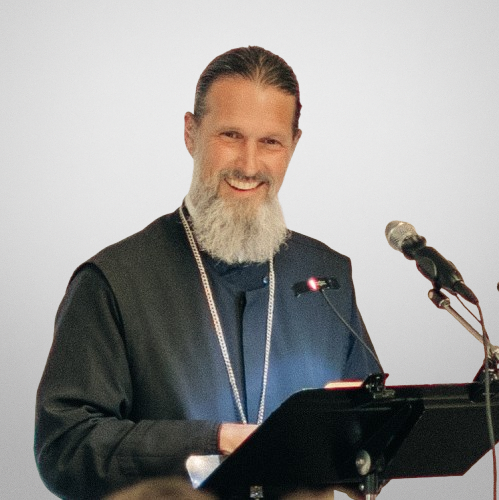
Elder Ephraim of Arizona: Life, Monasteries, and Teachings
Elder Ephraim of Arizona, abbot of Philotheou Monastery on Mount Athos and founder of St. Anthony's Monastery in the Arizona desert, brought the living tradition of Mount Athos to North America, where he founded nearly twenty monasteries. A disciple of St. Joseph the Hesychast, he heard the confessions of thousands, taught the Jesus Prayer to a generation of American Orthodox Christians, and reposed in 2019. This lecture, given during his lifetime, traces his formation, his mission, and the challenges of planting monasticism in America.
Note: This article is an automatically generated transcript of an audio lecture. It was transcribed and lightly reworded for readability using automated tools, so it does not reproduce the speaker’s exact words. For the original, listen to the recording linked below.
Listen to the original lecture on Patristic Nectar →
Key takeaways:
- Brought Mount Athos monasticism to North America, founding nearly twenty monasteries
- Major popularizer of the Jesus Prayer and daily prayer discipline
- Transformed confessional life by hearing thousands and training confessors
- Monastic formation stresses silence, humility, repentance, obedience, and frequent Communion
- Pioneering abbacy created cultural tensions between Athonite rigor and American parish life
Who Elder Ephraim was and his formation with Elder Joseph
Tonight, our focus will be on Elder Ephraim of Arizona.
He was born Ioannis Moraitis on the 24th of June in 1927. [Editor's note: Sources differ on the year; many give 1928.] That is the feast day of the Nativity of St. John the Baptist, and hence he was named Ioannis. He was born in Volos, Greece, to pious parents. His mother was named Victoria, and she ended up, before her repose, becoming one of his nuns. A beautiful story.
He lived in a poor family, a fact he describes in the preface to his book Monastic Wisdom, a collection of the letters of his spiritual father, Elder Joseph the Hesychast. During the German occupation of Greece in the 1940s, he had to stop school in order to work.
At his local church in Volos there was a hieromonk who was a spiritual son of Elder Joseph the Hesychast, an incredible figure and devoted man of God on Mount Athos. It was through this hieromonk, who was pastoring the local church where Ioannis was going to church, that Ioannis first learned about Elder Joseph. Ever since he was fourteen he conceived the idea of becoming a monk and meeting Elder Joseph.
When he was nineteen that dream came to fruition. He visited Mount Athos and became one of Elder Joseph the Hesychast's twelve spiritual sons. These twelve spiritual sons would, following the repose of Elder Joseph in 1959, go on to repopulate and revive monastic life on Mount Athos and in many other places as well. A truly incredible group of men, synodia. In fact, no one has promoted Elder Joseph the Hesychast's witness, sanctity, and teaching more than Elder Ephraim of Arizona.
Through biographies, books on his teachings, and the preservation of his relics, Elder Ephraim has kept Elder Joseph's memory alive. If you go to St. Anthony Monastery today in Arizona, you'll have an opportunity to venerate the head, the skull, of Elder Joseph the Hesychast.
This is a common theme you have no doubt noticed among the contemporary elders we've surveyed: they all had a tremendous devotion to their spiritual fathers and viewed it as their duty to imitate them and to pass on their way of life. Think of Elder Sophrony, St. Silouan, Elder Ephraim, and St. Joseph the Hesychast.
As a nineteen-year-old, Ioannis came to Mount Athos looking for Elder Joseph. He had had no contact with him to that point. Elder Joseph was living in a little skete called St. Anne's Skete in great deprivation at the time on Athos.
Just prior to Ioannis coming by boat to Mount Athos, St. John the Baptist appeared to Elder Joseph and told him this: "I am bringing you a little lamb. Put him in your sheepfold." After Elder Joseph had this revelation, he sent one of his spiritual sons, Father Arsenios, down to the docks to wait for the young Ioannis.
When Ioannis came off the boat, Father Arsenios was standing there and said, "Are you Johnny from Volos?" Completely shocked, Ioannis was then told, "Oh, good. Geronda is waiting for you," and Father Arsenios took him to meet Elder Joseph the Hesychast. You can imagine the beginning of his monastic life on that footing. Amazing.
He would spend the next twelve years of his life, from 1947 to 1959, living in the closest contact with Elder Joseph and the eleven other men who were his spiritual sons, in a very demanding scenario.
If you've ever read about Elder Joseph, you know that he was extremely demanding, mostly on himself but also on his spiritual sons. He was extremely zealous. He taught them to fight against sleep: not to lie down, to stay up, and to struggle against carnal thoughts.
Elder Ioannis, who became Elder Ephraim, describes in some of his books that Elder Joseph had abusive nicknames for all his spiritual sons and used to call them all sorts of terrible things. Yet they all knew, by his way of life, how deeply devoted to them he was—full of great love for each of his twelve.
They lived in a little cave. The conditions were so difficult when Ioannis arrived that the monks were becoming sick and unable to continue because he pushed them so hard and they endured such deprivation, eating very little food. They ended up moving to New Skete on Mount Athos, where it was more temperate and they had more food; they all regained their health, all except Elder Joseph, who was older than them.
Elder Joseph ended up dying on the feast day of the Dormition, on August 15th in 1959, and he prepared all of his spiritual sons for his repose.
Elder Joseph loved the Mother of God. Elder Ephraim describes that whenever Elder Joseph would mention the Virgin's name—whenever he would say "the most pure Mother of God"—he would start to weep, no matter where he was or what he was doing. He taught them to have this great devotion to the Virgin, and she appeared to him and told him that he was going to die on her feast day. She said, "You're going to die on my feast day. You're going to come be with us."
Just before this, he took his last Communion, and when he took his Communion, Elder Ephraim says that he said to the brothers, "Provisions for the journey to everlasting life."
Just before his repose, Elder Joseph said, "Call the fathers of the Synodia to come and do their last metania, because I'm leaving." Elder Ephraim writes, "We all did our last metania, and we received his blessing."
Shortly thereafter, he stared up at the sky for about two minutes. Then, turning to us full of serenity and indescribable spiritual amazement, he said to us, "Everything is finished. I'm leaving. I am departing. Evlogite. Bless." He then bent his head down to the right, opened and closed his eyes and mouth calmly two or three times, and that was it. He gave up his soul to him whom he longed for and had worked for since his youth.
This is the death of the spiritual father of Elder Ephraim, Elder Joseph the Hesychast, as described by Elder Ephraim.
Abbacy on Mount Athos and leadership
Until this point in his life—when he was in his mid-30s, when Elder Joseph reposed—you can imagine the incredible 12 years he had.
He would spend the rest of his life, very much like Elder Sophrony did with St. Silouan, describing, applying, and teaching all of the things he gathered by being around this great man.
The next major move for Ioannis, who became Ephraim, was to become a hieromonk, then an archimandrite, and finally to be appointed the abbot of one of the 20 ruling monasteries on Mount Athos.
This monastery is Philotheou Monastery. When he became abbot there in the late ’70s and through the ’80s, he revived it and caused it to grow immensely. [Editor's note: He became abbot of Philotheou in 1973.] He also became the spiritual father of other monasteries on Mount Athos and saw to their repopulation as well.
The Holy Monasteries of Xeropotamou, near the port of Daphne on Mount Athos; Konstamonitou; Karakallou; as well as St. John the Forerunner Monastery, which is in Serres, Greece; the Panagia in Portaria, near Volos; and the Archangel Michael Monastery on the island of Thassos—a little island just to the east of Mount Athos—these were among those he cared for. The Archangel Michael Monastery was a convent that he established.
So, besides these four major monasteries and the many sketes for which he became spiritual father over the course of these years, he was also the spiritual father for other monasteries elsewhere in Greece.
I remember hearing a story from my own spiritual father. He was visiting Mount Athos, I think in the late ’70s or maybe the early ’80s, and he went for a short stay at Philotheou Monastery while Elder Ephraim was abbot.
He described to me, standing in the catholicon, the first time he ever saw Father Ephraim serve the liturgy.
When Father Ephraim came out the north door at the little entrance of the liturgy, the divine light was like lightning shining out of his face as he came through the royal doors. The uncreated light was just coming off his face. My father said he never forgot it, and he was gracious enough to tell me. It tells you something about this incredible abbot of Philotheou.
Now Elder Ephraim stayed at Philotheou and continued to take care of these monasteries on Mount Athos and throughout Greece.
From Mount Athos to North America and the rise of his mission
We might not have known him, and I probably wouldn't have chosen him to be in this lineup since he's still living. But in fact a tremendous change took place in his life that had an incredible impact on America, and not just America; all of North America, Canada also. [Editor's note: This lecture was given during Elder Ephraim's lifetime. He reposed on December 7, 2019, at St. Anthony's Monastery in Arizona, at the age of 91.]
Elder Ephraim is so important to American Orthodox Christians precisely because he actually brought the traditional Orthodox spiritual life and Orthodox monastic life to America. America is certainly, I think, the place one might consider most difficult in all the world to plant monastic life. We are about as far as monastics as you can get as a culture.
The late and great Professor John Romanides, who taught theology here in America for some years and then left and went back to Greece, said that the state of the American church was so worldly. This is what he said when he left: "The state of the American church is so worldly, it can only be helped or saved if Mount Athos comes to America."
In 1979 Elder Ephraim, who was serving at that time as the abbot of Philotheou, became very ill. Some of his spiritual children who were in Canada, I think in Toronto, basically begged him to come to receive medical treatment in Canada instead of receiving it in Greece, where they didn't feel he would be treated adequately.
This began Elder Ephraim's close association with many North American Orthodox Christians. When he was in Toronto for medical treatment, he met with quite a number of the priests in that area and, with a blessing, he heard their confessions. He found out very quickly, much to his surprise, that the priests really weren't confessing and that, pretty much, their people weren't confessing either; confession was not being faithfully practiced by Orthodox Christians in America.
So, with a blessing, he agreed to hear the priests' confessions.
I've read an account of what happened when he first did that. Remember, he was recovering from sickness. He heard the priests and found out—because they really weren't proficient—I'm embarrassed to say this to you—that we priests were not proficient in our own confessions. He saw them stumbling and halting as they tried to explain to him what their sins were, so he, having the spiritual gift of reading minds and being clairvoyant, began telling the priests, to help them, what their sins were.
The result for the priests was that they were deeply blessed because they finally 'got it out.' They went home, phoned their priest friends first and then their parishioners, and began to tell everyone about this confessor and what had happened. The next morning there were 300 people outside the house where he was staying to hear confessions. He spent the entire day confessing these people. The next day there were 1,000.
This began roughly fifteen years in which Elder Ephraim would come for large portions of the year from Mount Athos to Canada and then to the United States.
With the blessing of the late Archbishop Iakovos of the Greek Archdiocese—which was no easy blessing to get—he received permission to be on a circuit as a spiritual father, going from parish to parish. I remember hearing from some of Elder Ephraim's monks that he went in the early morning for an appointment with Archbishop Iakovos to get his permission to become a confessor and waited in the waiting room until the end of the day. I think they were hoping he might leave, but he didn't. He waited seven or eight hours, and he got the meeting and he got the blessing.
It began this incredible ministry of confession all across North America for many thousands of people, which is still going on. But it went on intensively from the late 1970s until the mid-1990s.
At that time the holy community of Mount Athos—remember, the holy community is made up of a representative from each of the twenty major communities, the ruling monasteries on Mount Athos—appealed to Elder Ephraim and said, "You need to choose. Are you going to stay here on Mount Athos and shepherd your flock here or are you going to spend your time in America?" The community said, "Decide which way you want to do and go do it with our blessing."
He chose America.
Around this time many bishops were raising the issue of the heresy of ecumenism, and Elder Ephraim was very concerned about this. It's my understanding that he actually left the Ecumenical Patriarchate for a period and went into communion with the Russian Orthodox Church Outside of Russia. Evidently that didn't go on for very long, and he did return.
I don't know if there was a succession of patriarchs or exactly what happened. I haven't been able to pin down all the details, and it's a rather sensitive episode, but I do think it's part of the reason that Elder Ephraim functions as a spiritual father but not as abbot of any of his monasteries. I think that was a consequence of that period of uncertainty between the Greek Orthodox Archdiocese and the Russians and his participation with them.
Foundations in North America and Saint Anthony Monastery
How, in fact, did Elder Ephraim come here to America and what was the result?
If you read the lives of great monastic builders—monastery founders and builders like Saint Sava and Saint Theodosius, who built up incredible monastic communities with hundreds and hundreds of monks—you'll recognize a prototype that Elder Ephraim very much follows.
Establishing a few monasteries is a major feat, but since he came here in the mid-90s Elder Ephraim has established 18 monasteries in North America. [Editor's note: His first North American monastery was founded in 1989. St. Anthony's Monastery lists seventeen affiliated monasteries; other sources count nineteen.]
If you've been to his monasteries, you know none of them are cheesy, cheapo monasteries. These are monasteries that required tremendous investment and in which the Athonite tradition has been cultivated and reproduced.
Of course, these 18 monasteries in North America are in addition to the monasteries on Mount Athos and in Greece of which he remains spiritual father.
The one perhaps we're most familiar with, because it's the closest male monastery to us, is Saint Anthony's in Florence, Arizona. It functions as the great lavra for Elder Ephraim's work.
He established it in 1995 with six monks. He traveled there with the late Metropolitan Anthony of San Francisco, God rest his soul, who was the Greek metropolitan of California and Arizona.
Elder Ephraim was driving with Metropolitan Anthony in Florence. Outside the monastery the land is barren desert; the monastery is an oasis in the middle of that barren land. None of that was there when Elder Ephraim and Metropolitan Anthony first came to the property.
Elder Ephraim walked across the desert, heard bells ringing in the silence, and turned to Metropolitan Anthony saying, "This is the property, this is the place."
They started the monastery; it prospered and became the source, the feeder, for the other monasteries in North America that he established.
I once heard a beautiful story from one of the monks there. The monastery has numerous holy sites and places—churches, chapels, gardens, and a winery. It is an incredible place, and it has a beautiful cemetery. Our dear Joni Christopher, whose funeral we just had last week, is buried there.
Presbytera Catherine Hartung, who was here when she passed away—Fr. Luke's wife—is buried there. Many beautiful people are buried beside the monks.
When they started the monastery, a few neighbors were unhappy about the cemetery.
Partly it was because Elder Ephraim began burying people without permits. I don't know if you need permits in Greece if you're Elder Ephraim; probably not. But in Arizona, evidently you need permits.
One of the neighbors took the matter to court.
Elder Ephraim went with a translator to court. The person brought the complaint: "This man is burying people in the desert." The judge asked, "Is that true?" The person answered, "Yes, yes, it's true." The accuser added, "He doesn't have a permit." The judge asked again, "Is that true?" The person replied, "Yes, yes, I don't have a permit." The opponent said, "Well, case closed, it has to stop." The judge then asked, "Still, do you have anything to say?" Elder Ephraim answered, "Yes, I do have something to say. And please, it's only temporary. It's only temporary." The judge said, "Oh, good, only temporary." He asked, "How temporary?" Elder Ephraim told him, "It's only until the Second Coming of Jesus and the universal resurrection. They're all going to come out. They're all going to come out." The judge looked at the person and said, "It's only temporary, case closed."
From that monastery, 225 monastics have been formed since 1995 and have gone off to other monasteries. They formed the synodia of monasteries and convents in North America under Elder Ephraim's guidance.
Usually the men were formed there. He discerned who could function as an abbot, and when a new monastery was to be started he would take that man and elevate him to abbot.
For instance, I visited once, I think in 1996 or thereabouts, and there was a guestmaster who touched me deeply—just so beautiful and humble. He was a deacon at the time, Deacon Joseph.
I went back some years later and he was gone. I asked, "Where is he?" I found out he is now Hieromonk Joseph and the abbot of the monastery they started in Michigan. That's how it works.
The network of monasteries he founded in North America
The 17 other monasteries besides St. Anthony in the Arizona desert include the Holy Monastery of the Nativity of the Theotokos, led by Abbess Theophano. I spoke there last Lent; I was their guest speaker for their annual fundraiser. This is where Fr. Demetrios Carellas served as chaplain for many years; it is an incredible monastery just outside of Pittsburgh.
The Holy Monastery of St. Cosmas Aetolos, led by Abbess Alexia, is in Ontario, Canada.
The Holy Monastery of the Panagia Parigoritarissa, led by Abbess Thecla, is in Quebec, Canada.
The Holy Monastery of St. John Chrysostom, led by Abbess Melania, is a large women's convent in the Kenosha area of Wisconsin, just outside of Chicago. It held the incredible symposium in 2007 on the 1600th anniversary of St. John Chrysostom's repose.
The Holy Protection Monastery, led by Abbess Olympiada, is in eastern Pennsylvania.
The Holy Monastery of the Theotokos of the Life-Giving Spring, led by Abbess Markella, is the closest of Fr. Ephraim's female convents to us; it is in Dunlap, just east of Fresno. Many of you visit there.
The Holy Monastery of St. John the Forerunner, led by Abbess Efpraxia, is in Goldendale, Washington. It is a very popular monastery.
Holy Archangels Monastery, with Archimandrite Dositheos, is in Kendalia, Texas.
The Holy Monastery of the Panagia, with Fr. Modestos, is in Williston, Florida.
The Annunciation Monastery, led by Abbess Agapia, is in Reddick, Florida.
Holy Trinity Monastery in Smiths Creek, Michigan, is tended by Hieromonk Joseph.
The Holy Monastery of the Panagia, led by Abbess Agni, is in Troy, North Carolina.
The Monastery of the Panagia Pammakaristos, with Hieromonk Nektarios, is in Lawsonville, North Carolina.
The Holy Monastery of St. Nektarios, with Hieromonk Joseph, is in Roscoe, New York.
Holy Transfiguration Monastery, with Abbot Akakios, is in Harvard, Illinois.
The Holy Monastery of St. Paraskevi, led by Abbess Paraskevi, is in Washington, Texas.
These are the monasteries. Of course, this doesn't reflect all of the priests for whom Fr. Ephraim serves as spiritual father, or the thousands and thousands of lay people who visit his monasteries.
Until very recently, he would go to each of these monasteries and use them as centers in order to hear people's confessions and to help them.
Daily life, Lenten practices, and emphasis on the Jesus Prayer
As I mentioned, he's still with us. I believe he's in his late 80s.
At least until very recently, he used to spend Lent in the desert. He would walk out of the monastery and come back a very long time later. No one knew where he would go.
Let me give you just a smattering of his teachings.
What are the distinctives of his teaching? In Elder Ephraim's instruction, his writings, and his teaching, you feel the presence of Elder Joseph the Hesychast. His influence is huge.
At the very top of the contributions that Elder Ephraim has made, especially to North America, is his teaching on the Jesus Prayer.
In fact, I would say that he has been the key proponent and the major popularizer of the Jesus Prayer in the Western world. I'm not sure anyone has done more to encourage Orthodox Christians to utilize the prayer and to cultivate regular prayer with God through the use of the Jesus Prayer like Elder Ephraim.
If you go to St. Anthony Monastery, you will no doubt see many of the novices. The novices are often assigned to obediences while people like us who are visiting walk around admiring the trees, the chapels, the wineries, and the vines.
You'll see the novices watering, hammering, and driving trucks. Because they're novices, they are taught by Elder Ephraim to say the Jesus Prayer out loud. They're usually saying it in Greek, "Kyrie Iisou Khriste eleison me."
You hear them whispering it while they're working: "Kyrie Iisou Khriste eleison me, Kyrie Iisou Khriste eleison me, Kyrie eleison me." They say it everywhere they are. It's a beautiful witness.
Older monks don't have to do that, but this is the place to start for novices and for people like us — use our mouths until our minds have the impression, our hearts have the prayer, and the prayer can go.
Visiting any of his monasteries, you immediately see the prevalence of his emphasis upon the use of the Jesus Prayer.
Of course, he teaches that this is successful if it's undergirded by the virtues of humility, repentance, and obedience — basically the same things that he learned and was taught by Elder Joseph.
He also emphasizes in his monasteries the practice of silence. If you would go to St. Anthony, you'd find that in the middle of the night there's an hour of silence. I don't know if they still do it, but they used to gather outside of the main St. Nektarios Church at midnight and say the prayer. One would recite it and nobody else would say anything, cultivating silence.
Monk's summary of his teaching and key spiritual prescriptions
I wrote a friend of mine who's a monk there when I told him I was going to give this lecture. I asked him if he would summarize in his own words what he thinks Fr. Ephraim has contributed to us in his teachings. These are his words.
He says, "Geronda Ephraim teaches that if one continues in the pure pathway of the Fathers, guided by an empirically knowledgeable guide, it inevitably leads to illumination, which he always describes as the gift of ceaseless prayer given actively in the heart by the Holy Spirit."
Continuing forward, he says, "If the spiritual child progresses in humility and through his spiritual father's prayers, fostering the prayer and the other components of the spiritual life, like the holy liturgy and the mysteries, he will proceed to theosis as a result of his obedience."
He also notes "the absolute necessity to find a spiritual father who knows this way by experience."
He says, "I'd like to stress the wonderment that when an elder has already passed through the stages of purification, illumination, and theosis, like Geronda Ephraim has done, like he himself found when he went to Elder Joseph in the desert of the Holy Mountain, then the disciple can inherit his father's blessing and the grace of God can come through that relationship."
In short, this very transmission of the hesychastic tradition of the Fathers is the core of Fr. Ephraim's teaching.
Geronda Ephraim stresses a few simple things over and over again, reminding us and strengthening us with his prayers: silence, prayer, the remembrance of death, humility, patience, and love, like six seraphic wings which we fledglings are trying to grow by in the grace of God.
Confession, commemorations, and the departure of the soul
The first part of his teaching I would emphasize is his tremendous emphasis upon the use of the Jesus Prayer.
The second is his emphasis upon the practice of confession of sin. I've already mentioned to you the incredible role he's played as a father confessor in North America, both in Canada and the United States, teaching priests even how to confess themselves and how to be confessors, and teaching people to make confession and to practice their faith in a serious way.
From 1995 until about 2010—the first 15 years of life at St. Anthony's—Fr. Ephraim would often spend more than 12 hours a day hearing confessions. That was normal for him.
This is what he basically gave his life to until very recently.
In addition to the Jesus Prayer and the practice of confession, he places great emphasis on commemoration in the Holy Liturgy and on the importance of the prayers offered at the altar during the divine services.
As a result, at every liturgy—every day at St. Anthony's—they commemorate 40,000 names. Different monks keep the papers, but that is how many particular people are named in prayer in the monastery churches every day: 40,000. That's tremendous. What an encouragement.
Besides commemorations, there is the remembrance of death. The monastery has been preparing a very definitive work: a 1,000-page tome on the departure of the soul and the sacredness of the 40 days of making a transition to the kingdom of God.
I know about this book because the monastery contacted me and asked me to read it, review it, and write an endorsement, which I did. I've heard it has been printed, and I'm waiting to see it because I think it will be a tremendous contribution to a serious, patristic view of dying that's much needed in our country, which, as you know, has a very cheesy view of death.
He also emphasizes vigil and frequent Communion. The Liturgy is served every single day in his monasteries where they have priests; most of them do.
Selected sayings and published works
I selected a few quotes from him. This is his teaching on the thoughts: "How precious is the time of this life! Every minute has great worth, for within one minute we can think so many things, good or evil. One godly thought raises us to heaven, one diabolical thought lowers us to hell. Behold how valuable every minute in this present life is."
Here's a word from him on repentance: "Repentance is endless. All the virtues, by the grace of God, may be perfected by man, but no one can perfect repentance, since we need repentance until our last breath. For we err in the twinkling of an eye, and therefore repentance is interminable."
Here's a word on illness: "The most effective medicine for spiritual health is bodily sickness. Illnesses force the soul that has become careless because of its spiritually harmful physical health to get back to the right way of life."
He adds, "The slaps of pure love are absolutely never occasioned without a holy and saving purpose foreseen." When the Lord gives you that slap where you need it, by letting you get sick, it is because he has something beautiful for you.
He's also very famous for saying, "Occupy. Occupy. Occupy your thoughts. Occupy the lanes of goodness. Occupy the kingdom of God. Take action."
Many of you are devoted readers of Metropolitan Hierotheos (Vlachos) of Nafpaktos, who has written some material about Elder Ephraim and about his monasteries. He says about his time when he met him: "His words were very compunctionate, very sweet, penetrating and revealing, clairvoyant, renewing, healing, and extracted from patristic wisdom."
Metropolitan Hierotheos continues: "It is significant that the spiritual words contained in his book, which emanate from the vigils and stillness of the Holy Mountain, are presented to America where, on the one hand, a great disillusionment with the rationalistic and sensualistic atmosphere prevails, and on the other hand, a search for authentic life is being observed."
He concludes, "Papa Ephraim received fire that comes from the life of St. Symeon the New Theologian. Papa Ephraim received fire, and he has imparted this fire to many monks on the Holy Mountain and in turn to the Church in America that has great need of it."
I want to show you a few of his books. Monastic Wisdom: The Letters of Elder Joseph the Hesychast has a tremendous ten-page introduction by Elder Ephraim about his life with Elder Joseph in beautiful, intimate detail, as well as a collection of his spiritual father's writings. This was published in 1998: 81 letters of Elder Joseph with an epistle to a hesychast at the end.
Counsels from the Holy Mountain is a selection from the letters and homilies of Elder Ephraim that was published in 1999 by the Monastery of Saint Anthony. My Elder Joseph the Hesychast was published in 2013, a 700-page tome about the life of Elder Joseph. Another book, published by one of his monasteries in Roscoe, New York, is The Art of Salvation: 33 homilies on the spiritual life by Elder Ephraim, as well as about 100 recorded homilies from vigils, especially in the 80s, from Philotheou Monastery.
Controversies, cultural challenges, and pastoral reflections
I want to end by saying a few words about his absolute importance in America, and also about the absolute shock of this explosion of monasticism in a country that has no respect for asceticism; that lack of respect is the definition of materialism.
This colossal work to bring Mount Athos and plant it in America has been attended by outrageous controversy and struggle. Absolutely; as you would fully expect.
How is it possible that monasticism could come to America without serious controversy? I just think it's impossible. There is no way we can plant this kind of heaven-seeking, earth-denying way of life without controversy in America.
Monasticism has always been controversial in the Church, especially with parents whose children run off to monasteries when they have other plans for them. Parents want them to be a doctor, to have a bunch of kids and give them grandkids, and when that does not happen it can be very shocking, and sometimes much more than that.
Add to that the fact that Elder Ephraim has been doing this since 1995 as a pioneer, really by himself. We have 75 monasteries now in America, but apart from Elder Ephraim's monasteries—his 18—most of the monasteries are rather small, very small.
Most of the monasteries are pioneered by courageous people, but they are not connected to a strong monastic tradition like the one Elder Ephraim brings from Mount Athos. Mount Athos has eleven centuries of strong, clear monastic traditions that are being planted here, which is one of the reasons that his monasteries, he insists, continue to use Greek.
I once asked one of the abbots if that was going to continue, because it can be very off-putting to American pilgrims, including myself, simply because sometimes we cannot understand what we want to hear in the services. He said, "It's the elder's will."
I asked, "When is it going to stop?" He said, "Not sure." I asked, "Why is it this way?" The abbot told me, "It's the elder's will." I said, "That's a very good answer." I got the feeling that the door was open for an accommodation to American life, in English, once it was clear that these monasteries were established and the authentic tradition he had brought here was fully established.
Because he was doing this pioneering work, many young people have flocked to the monasteries. A lot of his monasteries are full of young novices who have no idea what they are doing. They have black cassocks on, and they are learning to say the Jesus Prayer with a hose.
One of the biggest temptations, of course, when you are a young American novice and have been there a year, is to blab. This is one of the greatest causes of controversy in the establishment of monasticism here: blabbing novices. I am sure it is a tremendous grief to Geronda to have novices who blab.
Many of our people go to the monasteries, and they like to talk. That's really not a great idea when you go to a monastery. The point is to have reflection, quiet, and some silence.
If you get connected with a blabbing novice, who knows where you will end up. You will be deciding exactly what 666 means, and you will be calculating the date of Jesus' return. It is so clear.
Sometimes you'll even find that there is not a lot of mutual symbiosis between parishes and monasteries. Mistakes have been made on both sides.
Sometimes there is not enough respect for parishes and pastors from the monasteries. Sometimes—I'm tempted to say often, but at least sometimes—we have suspicion of monastics; we are concerned about their way of life and we do not get it.
Sometimes lay people even say, "What exactly do these monks do?" Our standard in America is product. Why would a person become a monk or a nun? What are they producing? Of course, that is a very worldly way of thinking.
They are producing holiness, and they are actually buying the whole world time to repent. We should be deeply thankful.
Add on top of that that the monastic life, especially the Athonite life, is not a life of economy. Mount Athos is its own peninsula for a reason. It is very far from parishes, and parishes are very far from it.
There is one way of life for monasticism, and there is another way of life for Christians in parishes with regard to certain matters. We practice something all the time called economy—pastoral economy. There is no such thing as economy on Mount Athos, and there should not be. Monks are not about economy. If they wanted economy, they would be staying with us.
They went to Mount Athos because they wanted akrivia. They wanted exactitude, and this is how it is done. If they cannot get it there, where are they supposed to go to get that?
We have to be very careful when we go to places like that not to be offended that they are not comfortable with our economy, but conversely they need to be careful not to try to impose monasticism upon lay people. These are some of the sensitive realities about interactions between parishes and monasteries.
I'll give you an instance where this is difficult. In our parishes, especially in the West where we are a minority in a large Christian majority, we often receive non-Orthodox or heterodox Christians by economy. If they have some form of heretical baptism, we do not always insist that that be completely disregarded, and sometimes we receive people by chrismation if they have some form of baptism as a Catholic or as a Protestant. There are laws that govern that, but this is economy, and it is ancient.
Monks do not do that. They never have, and they never will.
But you can imagine if you have in Phoenix a nice parish and in Florence an Athonite monastery the tension that might cause. Imagine someone received by the nice parish priest by chrismation because he is a convert from Catholicism, and then he goes down to the monastery and a monk says, "You were received by chrismation. That's not the right way. You should have been baptized."
Then he says, "Baptized? Well, my pastor's not going to like that. Well, could you do it, and we just won't tell him?" I wish I could say that has not happened. In fact, it has happened many times, and you can imagine a more inflammatory occasion.
These are the kinds of things through which we are struggling to live together and to make sure that we respect each other. We are trying to do that.
Sometimes we Americans are so shocked. Remember that all of the elders we have studied so far in this class are far away: Romania, Russia, Greece, even Elder Sophrony, who brought this life to the West but not to America. Elder Ephraim is the one who has brought this to us here, and the result is that he is very unique in America.
Sometimes people who have become his spiritual children will talk about him in a way that is off-putting to someone who does not know him. They'll talk about Elder Ephraim as "the elder," where "the elder says this" and "the elder says that," and someone is left saying, "What do you mean 'the elder'? Aren't there lots of elders?"
Because he is kind of alone here in his valiant struggle, a form of guruism can grow. I like to call them hesychast hunters. These hesychast hunters can grow, and you end up having some people in parishes who grow dissatisfied with their own parish priest because he is obviously not a hesychast, and you can't make any progress if you don't have a hesychast.
I have actually functioned for many years as a reconciler between people who have been offended in parishes and the monasteries of Elder Ephraim because I love them dearly. One of the things I see a lot is a form of guruism that is no doubt very grievous to Geronda. The last thing a holy elder wants is people running around talking about him. It is a nightmare for him.
These people really want to know him because it makes them feel good. Sometimes we feel good because somebody important knows us, so we will talk about it and let everyone know, "Hey, we have a relationship with the elder." That's very sad. That just means the elder hasn't had enough relationship with you. You better get in a little deeper, or you wouldn't be talking this way if you had it. Very immature.
These are the controversies that have sometimes attended the planting of monasticism in our country, but I think we are working through them and we have a tremendous blessing. I wanted to end on this tremendous blessing of what Elder Ephraim has done for North America and for people in the United States.
We are in his debt as a church.
Amen.
Audience question and pastoral counsel
An audience member mentioned reading Elder Ephraim's The Art of Salvation and noted that it is very rigorous in places, since many of its homilies were addressed to monks.
Yes. It's a great question. This gets to what I had mentioned about mutual respect for different ways of life. If our Marines were always making fun of the Army, if they were always mean to each other, they wouldn't collaborate very well. We're all in the Army, but we're not all the Marines. There is a standard, and the people who are Marines voluntarily became Marines, and we honor them for that. They're the shock troops, and that's what our monastics are. They've run ahead of us, and we thank God for them.
The principle that we follow is: the monks look to the angels, and the laypeople look to the monks. For an angel to look at a monk and say, "Shame on you that you're not an angel," or for a monk to look at a layperson and say, "Shame on you that you're not a monk," this is very sinful.
If we read homilies given to monks and forget the gap between that life and our own, we could misread them terribly. The principles are the same; the ethics are the same. But the application is very different if you have a wife and children and a job, or if you're spending ten hours a day in the church temple.
So I would simply say, don't be stumbled. Look for the principle and ask yourself, How do I apply that principle where I am instead of applying it the way he might be telling a certain synodia whose life is that? Does that make sense?