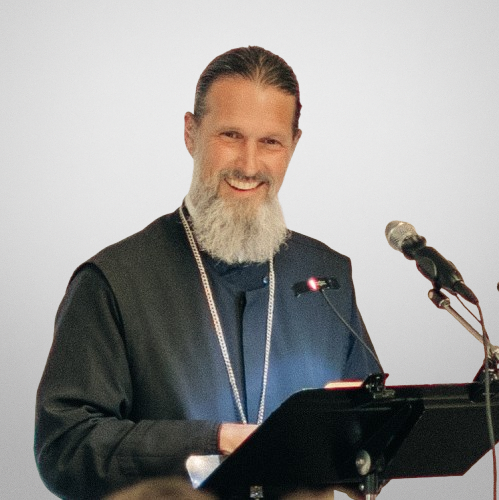
St Porphyrios of Kafsokalyvia: Life and Teachings
St Porphyrios of Kafsokalyvia, also called St Porphyrios of Attica, was a 20th-century Greek elder who fled to Mount Athos at twelve, was formed there in obedience, and spent thirty-three years as chaplain of the Athens Polyclinic. Unschooled yet clairvoyant, he became a confessor to thousands and was glorified as a saint in 2013. His life shows that spiritual gifts grow from obedience and humility, and that a city can become a desert for a heart that loves Christ.
Note: This article is an automatically generated transcript of an audio lecture. It was transcribed and lightly reworded for readability using automated tools, so it does not reproduce the speaker’s exact words. For the original, listen to the recording linked below.
Listen to the original lecture on Patristic Nectar →
Key takeaways:
- His spiritual gifts, he said, were given to him on account of obedience
- He memorized Scripture and services, enabling liturgy and homilies without books
- Thirty-three years as Polyclinic chaplain: daily liturgy, bedside communion, and healing
- Hidden elders passed grace through silent presence and spiritual caresses
- He urged families toward children, humility, prostrations, and steadfast love of Christ
Birth, poverty, and early longing for the desert
Elder Porphyrios was born in the village of Agios Ioannis (St. John) on the Greek island of Evia on the 7th of February in 1906. To his pious parents, Leonidas and Eleni, he was baptized Evangelos. He was the fourth of five children and was born into an exceedingly poor, physically poor family. Not spiritually poor, but physically poor. In fact, his father had to leave the family when he was a very little boy and go to the Americas and work on the Panama Canal to make money to send home to his family.
That is a spirit worthy of admiration. That's what his dad did. The consequence in little Evangelos' life was that he had to drop out of school after one year of education. He had one year of elementary school—that was it, his whole formal education. And yet he became a luminary for the world and a great counselor to the most educated. When he was seven, he took a job. He had to work in a little store to help support his family. He worked with animals and on his small family farm.
Later he moved to Piraeus, the port area of Athens, to work in a shop owned by a relative. From his early days he had a great desire to love God. In fact, he stumbled upon a copy of a life of a saint when he was a little child in elementary school. The saint was St. John the Hut-Dweller (Calybite). His is the beautiful story of a very privileged young man who fled privilege to live in anonymity. He returned home and lived in a little hut at the gates of his parents' house, so emaciated and dirty that his parents never knew who he was. He didn't reveal his identity until the end of his life. Evangelos loved the quest for anonymity that he found in St. John the Hut-Dweller. It so impressed him that he ran, basically, for anonymity his whole life.
He wanted to live in the desert. Even when, by God's providence, he came into the heart of the city near Omonia Square, which in recent years has been the site of protests in Greece about austerity and other issues, he spent decades there but lived in anonymity and as though he was still in the desert. He learned that from St. John the Hut-Dweller when he was little.
He had conceived the idea that he was going to make his way to Mount Athos by himself when he was twelve. He actually got a ticket. He didn't have much money, that's putting it nicely. He tried several times to get there. He was totally scared, crying his eyeballs out. He was helped by kind people. Basically, on his third effort, he made it.
He got onto a boat going to Daphne, the harbor of Mount Athos. It just so happened that he was befriended by a monk on the boat. That monk took him, even though you're not supposed to go on Mount Athos when you're that age; when you're twelve, you're not allowed on. You have to basically be able to grow facial hair to go onto Mount Athos, let alone going when you're twelve with no protector or no one. But this elder from God, his name was Panteleimon, and he would become the spiritual father and the spiritual former of Elder Porphyrios. He met him on the boat. The monk asked him, the boy, what are you doing here and what's going on? Elder Panteleimon was enlightened, and basically said, okay, this is what you're going to do.
"You're going to come with me. When anyone asks you who I am to you, you're going to tell them I'm your uncle. And if anyone asks me, I'm going to tell them you're my nephew: your mother, my sister, died, and you're left an orphan, and if they put you out and don't let you on Mount Athos, you're going to die."
Adoption by elders and the primacy of obedience
Thank God, Father Panteleimon had been living as a hermit in a little cell on Mount Athos in the desert, I believe in the southern part of Mount Athos, and his half-brother, Father Ioannikios, was living with him. [Editor's note: Biographies describe Father Ioannikios as Father Panteleimon's brother; the two lived in the Cell of St. George at Kafsokalyvia.] They adopted this twelve-year-old boy and took great care of him.
That boy showed incredible spirit. Elder Porphyrios later said that he loved his elders like nothing else, that he clung to them like a leech. He said his heart was absolutely glued to Father Panteleimon.
Both of the monks were priests, but only Father Panteleimon was a spiritual father. Father Ioannikios could not hear confessions or give spiritual direction, but Father Panteleimon could. He became the spiritual father for the boy, formed him in prayer, and taught him incredible things. Elder Porphyrios spent his whole life absolutely fixed to the love of Elder Panteleimon. He said that just to look at his elder gave him grace.
As a matter of fact, he said he used to sit next to him in order to, quote, "inhale him." He pointed to an example from the Life of the Desert Fathers where a group of thirsty young monks were sitting around an elder asking him questions, and one monk was completely silent and did not ask anything. When the established elder asked him, 'Son, how come you're not asking me any questions?' the young man replied, 'Elder, it's enough for me simply to look at you.' Elder Porphyrios was deeply touched by this and said this was how he lived with Father Panteleimon. Just to be near him gave him grace. This is how pure of heart Father Porphyrios was as a young man. He breathed—literally breathed—grace apart from words from his elder.
He gathered some of his miraculous charisma, some of his charisma, his spiritual gifts, by standing near another monk when the other monk was praying in ecstasy. Without speaking to him, by secretly standing near him, the grace transferred to him. It's an amazing story.
He was tonsured as a monk at fourteen. He lived in the forest barefoot, serving his two elders. They usually left him in the cell when they went to the catholicon and to the big church meetings. They would leave him there in their little chapel until he was older in order to protect him and to make sure that, when he did make his appearance on Mount Athos, he would be an older young man and would be accepted. He refused to wear shoes. He loved to see his footprints in the snow.
He tells a touching story of once betraying the obedience to Father Panteleimon that he had been so committed to. Father Panteleimon had a book high up on the shelf, and he told Father—his monastic name went from Evangelos to Niketas, so he became Father Niketas when he became a monk—and he told Father Niketas, "Don't touch that book or look at it, because there are things in it that are not appropriate for you and too great." He accepted that with joy, but when the elders were gone once, he was overwhelmed by temptation. He snuck up and opened the book. It was the life of St. Symeon the New Theologian, and his elder did not want him to see it yet. From the moment that he touched it, he said he felt grace leave him. He could not say his prayer rule. He could not do anything. He was completely ruined, and when Father Panteleimon returned he immediately ran to his elder and confessed everything.
Father Panteleimon read the prayer for forgiveness for him, but that moment became foundational for him regarding obedience. It became the subject of his life for the rest of his life—the importance and the supremacy of obedience. This experience would later show itself in his life as a confessor, which is what he is most famous for. He was a confessor to thousands of people, and his own sensitive soul let him understand theirs and help them.
He was able to help them learn to trust Christ and their spiritual father and to be obedient. He says this about obedience. He says, "Obedience is something I have poured over and studied minutely. The other things that God has given me in my life came on their own, the gift of clear sight or clairvoyance. It was given to me by God on account of obedience." Remember the scripture from Proverbs, "I love those who love me, and those who seek me will find grace."
Memorization, prayer life, and practical asceticism
Once he had the inspiration to read the scriptures and to memorize them, he memorized scripture and the church services constantly. He actually didn't even know how to read when he went to the monastery. The way that he learned to read was to very slowly learn to pronounce the psalms, and over time he eventually learned to read. He decided he was going to read John chapter 1 and memorize the text, so he did. When he finally finished it and his elders came home, he recited John 1 by memory to the elders. Father Panteleimon said, "Shame on you for doing that without a blessing." Father Porphyrios said he laughed and giggled. He had been feeling that the elders were too soft on him; they weren't being hard enough on him, and so he was happy to be punished for memorizing John 1. He used that to point out that even a good thing, if done without a blessing when you're a monk, is not a good thing.
He loved the Psalter. He memorized all 150 psalms and the service books. At different points in his life he was stuck in circumstances where he was able to do services without any book at all, to the astonishment of those who had talked down to him because he was unlettered and hadn't actually gone to school. He was able to do an entire service or recount an entire homily of St. John Chrysostom from memory, and they sat there with their mouths open.
He loved to climb up the trees on Mount Athos, and even when he was in the city he would look for the forest. He made a little portable ladder, and he would throw it up on the tree, climb into a high part of the tree, pull the ladder up so nobody could find him, and spend half a day at a time with his books, reading. He had an insatiable curiosity born of love, so that wherever he was, with whomever he was, if something was going on in the life of a person he loved and he didn't know about it, he had to find out about it. He would read about it and study so that he could get into their life, feel what they were feeling, understand what was going on, and provide some help.
He learned handicrafts. He became a woodcarver, as so many of the hermits are on Mount Athos, and he learned to carve all sorts of crosses and other beautiful things so that they could have what they would call biscuit money, just a little bit of money so that they could buy some bread. Fragments of such handicraft culture remain.
I remember when I went to Mount Athos in 1997, a monk approached me and held out a handful of prayer ropes—little dinky prayer ropes, maybe 33 knots. He said, "This is my obedience. This is what I do to live; my elder has me making these little tiny prayer ropes." He gave them to me for a dollar each. That's how the monks often live. They're not looking to make a profit, just enough to eat.
When he finally became a monk, he was given a cassock, and it was the one thing that he was hoping to have new. He wanted a really nice black cassock. When Father Panteleimon tonsured him a monk, he went and got his old, ratty, hole-filled cassock and gave it to him. He said, "Here, this is your new cassock for becoming a monk." He said for five days he was sad, and then it became the happiness of his life that he actually was wearing the cassock that his spiritual father had worn, and worn out like that. After five days he considered it to be grace-filled and a tremendous boast, which he wouldn't give up—an old tattered rag.
Hidden elders, spiritual caresses, and clairvoyance
He was absolutely blown away by spiritual giants who lived at different places on Mount Athos, whom he ran into and constantly searched for. What he loved about them was that they were secret. Many of these men—giants whom he witnessed performing miracles—were unknown to others, and that's how they wanted it. They loved to be anonymous and to live in little hovels. One of them he tells about is an old Russian monk named Demas.
Father Demas lived in a little hole, literally a hole in the ground. Once Father Porphyrios, when he was still Father Niketas, got up two or three hours early on a feast day and went to the local church so he could pray before the other monks started arriving for service. While he was standing in the corner, Father Demas walked in. He made no noise because he wanted to watch what Father Porphyrios was going to do. Father Demas looked around, didn't see anyone, and began his kanonas, his prayer rule. He took out his prayer rope, made the sign of the cross, and began the Jesus Prayer. A few minutes in, he fell into complete rapture, into ecstasy. Father Porphyrios saw him making motions as if he were hugging someone; he appeared to be caressed on the head, saying, "Oh, thank you so much," and speaking as though out of his mind.
Father Porphyrios said that that experience—which became a common theme in his own teaching—led him to speak about a spiritual caress: how God gives spiritual caresses, how parents should give spiritual caresses to their children, and how important that is. He learned this from watching old Father Demas. He writes that the grace that that saint possessed radiated into his soul as well. The elder transmitted to him his spiritual gifts of grace. He says prayer and clairvoyance came to him from that experience.
The next day he was in his little hermitage, and the two elders had gone some miles away to get wood or something and were out of sight. He was standing outside and yet saw them clearly; he was raptured in spirit and able to see, just as the prophet Elisha saw events at a distance, what was going on with his elders. He later described to Father Panteleimon what he had seen. Father Panteleimon said, "All right, all right, don't give any importance to this, and don't tell anyone, because the evil one is watching us." It was a beautiful, traditional admonition about hiding events of grace and keeping them between you and your spiritual father or close companions.
Elder Porphyrios, at the end of his life, was asked how he could have such incredible spiritual gifts. He said the reason was that he always heeded the word of Father Panteleimon. He never considered the gifts he had important, and he never talked about them—the two things his elder had told him never to do. Because of that obedience, he was able to be used. By the end of his life he had performed many wonders: he would go places, be transported to places, heal people, and show up in moments of need. Elder Paisios the Athonite once said of him, "That man is a spiritual television." He could be on different spiritual channels all over the world and work many miracles. [Editor's note: In the published accounts, it was Elder Porphyrios himself who called his gift “spiritual television”; Elder Paisios humbly said that Porphyrios had a color television while his own was only black and white.]
He understood the language of animals and birds as well as the human heart. He could read people's dispositions very easily, and he loved animals and birds and would actually talk to them. He even learned about former ascetics from rocks.
Illness, return home, and ordination
He got sick, unfortunately, at the end of his teens. He became very ill, and his stomach began to hemorrhage. The monks—his spiritual father and Father Ioannikios—were afraid he was going to die, and they convinced him to go to the hospital. He returned to his village, Evia, and went to the hospital so that he could eat. They ate so sparingly there that they couldn't give him nourishing food—no eggs, no cheese, nothing of real substance—and he didn't want any of that. For that reason the elders insisted he go back and eat those things and have his health cared for, and so he did. [Editor's note: Biographies record that the illness that forced him to leave Mount Athos was severe pleurisy; his stomach hemorrhages came later in life.]
Returning home was very challenging because he hadn't seen his parents in years. His father had been away when he left, and he hadn't seen his mother since he went to Mount Athos. When he came back, she was furious; she wouldn't kiss his hand, she wouldn't embrace him. She considered it a personal affront that he had become a monk, and he tried to reconcile with her for a very long time. She was extremely stubborn, but after a number of years the grace of God in his life and his exceeding love—the thing he's most known for—wore her down.
She began to attend his liturgies because when he went home he was assigned to a local altar and began serving the liturgy regularly. He remembered her standing in the congregation looking directly at him; when he turned to give the blessing, she would sit there watching him. He saw her heart completely change; she became super faithful at all the services and began to call him 'my priest.' People in the village started to kiss her hand and call her the presvytera, even though she was his mother. They loved him so much that they honored her, and his mother's face would glow with pride. When she was elderly she confessed how sorry she was to have given him such a hard time and said she wished she had made all of her children monks.
He came back and got better. His father also returned, and in fact his father had a very noble soul and was a devout believer; he was a chanter in the church. Evia had been the place where St. Nektarios had been exiled between 1891 and 1893, and his father knew him. Can you imagine your father being friends with St. Nektarios? That's what his father was like. He and his father had a beautiful time together.
Father Porphyrios stayed at the monastery of St. Haralambos, and when he was only twenty years old the bishop of that area was hosting the Archbishop of Sinai, Porphyrios III. Father Niketas came to visit the archbishop as a simple monk walking with Archbishop Porphyrios. While they were having a discussion, the young monk used his gift of clairvoyance to tell the archbishop something that nobody knew. The archbishop stopped, looked at him, and declared that he was ordaining him a deacon and a priest. This is how Father Niketas became Father Porphyrios, named after the archbishop.
Some texts say he was ordained at twenty years old, some say twenty-one, and within two years he became a spiritual father and the flood of people began coming to him.
When he first became a priest he had always been devoted to his bishop, and he said Christians—especially priests—should be obedient to their spiritual fathers and to their own bishop. He said, "The bishop is a type of Christ; you cannot continuously repudiate your bishop; you cannot damage your relationship with your bishop, otherwise your prayers do not rise to heaven, your prayers remain fruitless." He served in Evia as a parish priest, then spent twelve years in the monastery of St. Haralambos, and then three years in the deserted monastery of St. Nicholas. Three times during these years he tried to go back to Mount Athos to be with his spiritual fathers again. He stayed just ten days, then fourteen days, then fell into a radical medical relapse all three times and finally consented that it was God's will for him not to stay any longer on Mount Athos. In fact, he wouldn't live on Mount Athos again until the very end of his life, when for the last six years or so he was able to return to his cell and die where he had started.
When he first became a spiritual father he was so enthusiastic that he actually heard confessions forty-eight hours straight without taking a break, not even a nibble. That's how many people were coming to him as a young confessor. He learned to make the city his own desert, and he said Mount Athos never left him. He kept the spirit he had when he lived in the hermitage and lived in the quest for anonymity.
Chaplaincy at the Polyclinic and hospital ministry
In 1940, on the eve of Greece's entrance into World War II, he moved to Athens. He was in his mid-thirties when he became chaplain of the Polyclinic Hospital and priest of its Church of St. Gerasimos of Kefalonia. [Editor's note: The Polyclinic chapel is dedicated to St. Gerasimos of the Jordan, not St. Gerasimos of Kefalonia.] A word about hospitals as he experienced them: the hospital as we know it today is an invention of the Orthodox Christian tradition in Byzantium. The church fathers instituted hospitals with physicians and nurses, building large facilities endowed to host and treat the sick. In Orthodox countries, hospitals have the church at the center and a clear connection to the local diocese. In the middle of the Polyclinic was a magnificent church dedicated to St. Gerasimos, and he became the priest of that church.
From there he served the liturgy each day and then visited all of the patients room to room to comfort them, to confess them, to give them Holy Communion, to cheer them up, and to study their problems. He stayed in that position from 1940 until 1973—thirty-three years. At the end, when he left to go to the monastery and to build a monastery for his spiritual daughters, a beautiful convent, he said that in his mind those thirty-three years were like one day. That's how much he loved to be with people, with the suffering, with the sick. For him it was absolute delight.
Because he wasn't in a big parish he was basically off the grid for external responsibilities. He could stay there, serve the liturgy, attend to the sick, hear confessions, and live quietly. He lived in different places—often no one knew where he lived. Sometimes he would sleep in the little room attached to the chapel; nobody had a clue where he was. The chapel was dedicated to St. Gerasimos.
There is a beautiful story about Father Porphyrios. He broke his shin in a compound fracture. The doctors fixed him wrong, and he discerned through his gifts that under the calf it was completely ruined. When he told them they mocked him for days and said, 'You arrogant priest, stick to your business. We're sticking to medicine.' He finally convinced them to re-X-ray it; they found it was ruined and had to re-break it, which they did with their hands. He was in pain for months. When he finally got out of bed after three months, they told him to use two crutches. He was afraid to use them because he thought they'd make him dependent, so he refused them.
As he argued with his doctor in the chapel a woman stumbled in and asked, 'Is this the church of St. Gerasimos?' He said yes. She prayed before the icon out loud. They overheard her thanking St. Gerasimos that he had come to her and helped her even though she didn't know who he was. He had told her, 'I'm St. Gerasimos of Kefalonia. I have a church in Athens at the Polyclinic Chapel. There's a priest there who needs my cane. That's your cane. You're going to take it to him this morning and give it to him.' They overheard her, then she turned and asked, 'Who is the priest of this clinic?' He said, 'It's me.' She said, 'Here, this is from St. Gerasimos.' He took the cane, chucked the crutches, and used the cane.
He called it from then on 'St. Gerasimos' cane.' Whenever he was praying for someone's healing he would take the cane and tap on that spot. He healed many people with the cane of St. Gerasimos. This is how attentive the saints are, especially to saintly people who love them so much.
He endured many illnesses himself—kidney problems, hernias, a heart attack, stomach hemorrhages—and spent the last years of his life completely blind in both eyes. That didn't divert him at all from caring for the sick, praying for them, and always bringing them communion.
He described how he viewed nurses: 'I loved everyone. I felt pained for everyone. And everything moved me. This is something that divine grace has given me. I saw the nurses in their white uniforms like alb-wearing angels. When I saw a mother breastfeeding her baby, I was moved. When I saw a pregnant woman, I wept.' This was his attitude towards healing and suffering. He celebrated the liturgy in the hospital with great intensity and love.
There is a famous story about his patience in prayer. When he hadn't been there long, a man who owned a shop directly across from the church and hospital—a gramophone shop—started putting his record player outside, blasting music to draw people in. Father Porphyrios found the love songs distracting during the liturgy and asked the man to turn down the music. The man said, 'I have sons to feed. I'm not going to turn it down. Mind your own business.' Father Porphyrios was so depressed he thought if he couldn't liturgize in peace he would leave. He had a vision: he was sitting by water, someone threw a little pebble making a small ripple, then someone threw a much bigger rock producing a bigger wave that overcame the little ripple. He was illumined that God was calling him to make his prayer in the liturgy the bigger rock. He prayed with more intensity, focus, and love, and from that moment, even though the gramophone never stopped, he never heard it again in the liturgy—his prayer overcame the distraction.
While serving the sick he was interested in everything. If a patient described a malady he didn't understand, he would immediately go home and buy books—medical texts—and consult doctors. He wanted to understand what was happening inside them so that he could minister better. This shows his pastoral competence: a true pastor seeks to be educated about his people's lives.
He also studied music. The conservatory was next to the hospital, and professors and students of music came to his chapel; he had choirs made up of professors, not just of medicine, and they had incredible choirs at his Polyclinic chapel.
The girl saved from suicide and commemorations
There is a well-known story of a 17-year-old girl named Effie. She was a beautiful young girl who had been seen talking on the street with a young man, and someone made terrible accusations as though it had been totally inappropriate. She was so offended by that criticism—especially because her family chastised her—that she decided to kill herself. She and her father were working in the garden, weeding. She saw a container of weed killer and convinced herself that when her father went back into the house she would drink it and kill herself. They finished working; her father went into the house; she put the weed killer in her pocket so he wouldn't see. Just as she was taking it out she heard a voice and turned to find a priest standing in her garden. He said to her, 'Sweetheart, I know what happened to you, and before you do anything I want to tell you about paradise.'
He told her about paradise—how beautiful it was and what a rest and consolation it is for everyone who struggles for it—and how much God loves us and that we should spend our days discovering how much God loves us and trying to love Him in return. He also told her about hell: 'Besides heaven there is something called hell, and hell is a terrible place of depression and discouragement and accusation, basically all the things you were feeling. If you kill yourself that's where you'll live.' She was completely changed; she put away the weed killer, turned to thank him, and he was gone.
She had never seen him before. Later, much later, she met him again with her family and recognized him—she told her father, 'This is the man who appeared to me in the garden and saved my life.' He smiled and said, 'How are you doing, sweetheart? Isn't what I said true?' She became his spiritual daughter, married, and had many children. Elder Porphyrios, like other elders, loved children and encouraged families to have them. This woman became a mother of life.
He had great confidence in the power of being commemorated at the prothesis, the proskomedia service before the liturgy. He cured many people by simply taking pieces of the loaf and putting them on the discos and having them commemorated in the holy liturgy. That shows how special commemoration at the prothesis is, so when you are in need you can ask for that or bake prosphora and bring it to church with your list.
Retirement, return to Athos, death, and pastoral anecdotes
When he finally retired from the Polyclinic, he moved to a little village north of Athens and spent his last years building up a convent of his spiritual daughters, who were nuns. His dream came true when he was able to move back to Mount Athos and return to the same desert that had formed his spiritual life. On December 2, 1991, he died. His last words were known to be from John 17, Jesus' prayer that they might be one—"that they might be one." He died with that phrase on his mouth.
He was famous for his universal love and openness. There is a story about bikers: at a monastery he was establishing—perhaps in Oropos—a biker gang in leathers burst in, parked their bikes, walked into the monastery, and mocked him. They said, 'Papouli, tell us something.' Father Porphyrios looked at the main gangster and said, 'Well, Dimitri, what would you like me to tell you?' He knew his name though they'd never met. He spoke to them, and these men became his spiritual sons. Father Porphyrios said, 'The souls of those boys are the purest of any who visit here.'
Another story: on Theophany, when he was blessing houses, he accidentally went to a house of ill repute, a brothel. He walked in and started singing the liturgical words. A woman objected, saying those girls were not worthy to kiss the cross. He said to her, 'Maybe it's my judgment that those girls are worthy to kiss the cross, and they're more worthy than you.' They all came forward, kissed the cross, listened to him, and he told them, 'My dears, really, God loves you more than you can possibly know. I want you to think about this and consider loving him back more.' He left; the accounts say those girls had an experience with Christ in their midst and were changed.
He was very simple. He tells a story that once he was eating at people's homes and didn't know how to use a fork—he had never used a fork in his life. A seven-year-old girl blurted out to her mother, 'Mommy, he doesn't know how to use a fork,' then, 'he doesn't know how to use a knife,' and so on through all three utensils. He was delighted. He watched how the kids held their forks and learned.
He gave this counsel: 'It's better to make mistakes in the church than to be correct outside of her.' This was a major rebuke to schismatics and purists who see problems in the church and want to leave. There's struggle in the church, but there's no leaving the church.
He counseled that when you pray, make prostrations even if it makes you tired, because prayer accompanied by voluntary sacrifice becomes more pleasing to God and more effective. He gave good advice about reading books: 'A bad book does you harm. A good book is good for you, even if you aren't ready to put into practice what you read, because you have the desire inside of you slowly, slowly, in time, without violence and pressure, the desire for the good and finally, you put it into practice.'
He said, 'Let us be humble, but not pretend to be humble.' He said, 'When I became a monk, I felt eternal. The church is a mystery, and whoever enters the church doesn't die. He is saved. He is eternal.' He taught that happiness can exist in marriage, but with one presupposition: the spouses must have acquired spiritual well-being—loving God and keeping His commandments. In this way they will truly love one another and be happy. Elsewhere he said, 'Consider that a bad wife may be your opportunity to make it to paradise.' He advised parents, 'Don't pressure your children. In your prayers, say the things you want to say to your children. When you want to say something to your children, tell it to the Panagia, to the Mother of God, and she will bring it to pass.'
He said, 'Whether we go to paradise or to hell doesn't depend on if we have a lot of money or a little, but on the way that we use the money that we have.' He observed, 'Today, people want to be loved, and for this reason they are unsuccessful. The correct way is not to be interested in whether or not you are successful.' About politicians he said, 'What can politicians do for you? They are confused by their psychical passions.' He also said we are partly to blame for our society's condition: if we were true Christians we could send to Parliament Christian politicians.
When a young theologian visiting Elder Porphyrios asked him about encouraging parents to have children instead of being demographically decimated by contraceptive culture, Elder Porphyrios responded, 'Tell them not to avoid having children. It's a great sin to avoid having children. It's a good thing that you're involved in this work. Continue, please. Tell them that avoiding having children is not allowed.' He said these were among the last words he ever spoke to that visitor, unprompted, and it echoes the common theme among contemporary elders about Christian population and family life.
He was also famous for reciting the Paschal homily of St. John Chrysostom from memory each Pascha, slowly and beautifully. Near the end of his life he wrote a letter to Elder Paisios. These saints knew one another. Elder Paisios was concerned about globalization and loss of identity and warned people about credit cards and barcodes and 666. Elder Porphyrios wrote to him saying, 'I know your great love. I know you'll listen to me. Stop talking about barcodes and stop talking about 666. Exalt the love of Christ so that people don't worry.' Elder Paisios, from that moment on, never spoke about it again the rest of his life. [Editor's note: We could not find this letter in published sources. Accounts do agree that Elder Porphyrios discouraged a preoccupation with 666 and the Antichrist and urged Elder Paisios to stop dealing with those subjects.] It's a beautiful story about how these saints mutually encouraged and built each other up.
Recommended readings and closing note
I am so inadequate to tell you about Elder Porphyrios' life, but you can read much more elsewhere.
The first is in English: Elder Porphyrios' Testimonies and Experiences—short testimonies from numerous people who knew him and had experiences with him. The second is Wounded by Love, the Life and Wisdom of Elder Porphyrios, a collection of his writings compiled by two of his spiritual daughters and edited by his convent. His life is also in Precious Vessels of the Holy Spirit, a short life and samples of his teachings. I've heard that one of his close disciples, Damianos, is making an official version. We're hoping, just like we got from Elder Isaac, that we'll receive an official massive life of Elder Porphyrios soon.