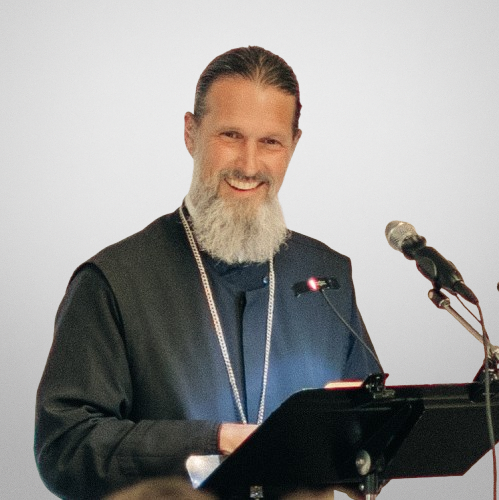
Principles of Orthodox Worship (Copy)
The principles of Orthodox worship teach that worship is the human calling to union with God, the purpose of creation, and the aim of redemption. Rooted in Scripture and the Fathers and expressed in the Church's liturgy and sacraments, these principles emphasize revealed form, incarnational practice, and the Holy Spirit's guidance. Practically, Christians are urged to attend services, use the Church's inherited prayers, and allow worship to shape daily life.
Note: This article is an automatically generated transcript of an audio lecture. It was transcribed and lightly reworded for readability using automated tools, so it does not reproduce the speaker’s exact words. For the original, listen to the recording linked below.
Listen to the original lecture on Patristic Nectar →
Key takeaways:
- Worship is the created world's purpose and humanity's chief vocation
- True worship is revealed, regulated, and animated by the Holy Spirit
- Liturgy unites word and sacrament, joining synagogue and temple traditions
- Regular communal participation sanctifies the faithful and shapes Christian life
- Freedom in prayer depends on disciplined practice of traditional liturgical forms
Worship as vocation, creation, and redemption
Number one, Foundational Truth of Orthodox Worship, number one. Worship is the quest for union with God. This is the whole purpose of divine services and of worship: to draw near to the Lord. This quest inspires every act of piety and every ascetical discipline, and it is the foundation upon which all of our services are built. We come here to be with the Lord, to be near Him, to enter into His courts and into the house of God. Number one.
Number two, Worship is the purpose of the creation. All physical creation is fashioned to glorify God. This is taught many places in Holy Scripture. I quote in your handout there, "The heavens declare the glory of God, and the firmament proclaimeth the work of His hands. Day to day poureth forth speech, night to night reveals knowledge. There is no place where their voice is not heard." This testimony describes the voice of praise coming from the created world: the heavens, the earth, the stars, the sun, the mountains, the trees. All of physical creation is to the glory of God. And St. Paul says in the first chapter of his epistle to the Romans that that which is known of God, concerning His eternal power and His divine nature, is clearly seen, being perceived by that which has been created. This is the theocentric message of the created world. The whole world says to you, Praise the Lord, and great is our God. This is what the mountains say and the clouds every morning, if you have ears to hear. This is what the air says and the wind as it goes by your face. Praise the Lord; let everything that hath breath, praise the Lord.
Number three, worship is the essence of being a human being. To be human doesn't mean merely that you have a nose, two eyeballs, and stand erect as a biped. There are persons who fit that category who would not be considered human by the fathers of the church. To be human is a statement of heart, of worship, and of morality. This is the glory; this is what it means to be a human being. The human, as the pinnacle of creation, carries an innate orientation toward worship and holds a chief place of leadership in the creation. All of that symphony of the created world is under the rule of the human being. We are to guide the creation in the praise of the Lord; the conductor of that symphony is the human being. We are to lead this cosmic praise as our chief act. This is why mankind was fashioned on the sixth day as the last of the aspects of God's creation: we are the pinnacle of His work, the crowning achievement of His glory. The first full day of human existence is the day of rest, the day of worship, the Sabbath. We were fashioned on the sixth; the first thing we knew was the praise of the Lord on the seventh. This is what it means to be a human being. The more we worship, the more human we feel; the more human we become.
Number four, worship is the very purpose of redemption. I have affirmed that it is the purpose of creation. False worship is at the heart of the fall of mankind. The destruction of the cosmos and the breaking of the fabric of this world took place because Adam no longer considered himself primarily as a worshiper of God. He stopped seeking the Lord's pleasure and began to seek his own. He set up an idol—his own satisfaction—and he bowed down to it. This corruption, this fundamental corruption of mankind, which we call the fall, is manifested chiefly in idolatry.
This is what St. Paul says again in his epistle to the Romans, the first chapter: "Even though they knew God, they did not honor God or give thanks, but exchanged the glory of the incorruptible God for an image in the form of corruptible man." For this reason, God gave them over. He then describes the perversities of fallen man. Notice that all of the forms of corruption we see—vice, debauchery, and other terrible things that grieve us—are subcategories of idolatry. The great sin is turning away from being a worshiper of the Holy Trinity. In his language, "though they knew God, they did not honor God or give thanks." This is the problem: a refusal to worship what we know. From that, God abandoned them in his judgments and gave them over to all forms of perversity. Notice the logic: it started with idolatry, a turning away and a refusal to worship the Lord; then the grace of God subsided and they lost control.
The heart of redemption, therefore, is the reestablishment of the human person as a worshiper of the Holy Trinity. We are redeemed to worship. This is why God has saved us. St. Peter writes this in 1 Peter 2.9, "You are a chosen race, a royal priesthood, a holy nation, a people for God's own possession, that you may proclaim the excellencies of him who has called you out of darkness into his marvelous light." This is the pattern: God acts to save us; we respond by recovering our calling as worshipers of the Lord God. We are chosen to worship in St. Peter's language.
And this is what we see in all the great salvific acts throughout the unfolding of redemptive history. When Noah comes through the flood and comes out of the ark, what's the first thing he does? He sets up an altar and worships the Lord God. When Moses leads the people out of Egypt, the first thing they do is worship the Lord God. When King David is delivered from his enemies, he builds the temple to the Lord God. When the people are delivered from exile, Nehemiah rebuilds the temple to the Lord God. This is the response to being redeemed. We're created and we're redeemed to worship; worship is fundamental to the Christian existence.
Worship as center, revealed, and regulated
Number five. Worship is the center of the Christian life. I use an image often in my pastoral work to try to cement you in your affections for the holy altar — the great rubber band. You've heard me use this, no doubt, many times: imagine yourself with a massive rubber band around your waist that goes around the altar and keeps you close. Everywhere you go — to school, to home, on vacation — you come back. Life becomes a movement with the church as its center, with the altar as its center, with worship at its center. St. Paul says that whatever we do, eating or drinking, whatever you do, do it all to the glory of God. This is the central conviction of our life. Colossians 3.17 he writes, "Whatever you do in word or deed, do all in the name of the Lord Jesus, giving thanks through him to God the Father."
The sixth foundational truth about worship is that worship is the one, the singular thing that the Father seeks from us. There's only one place in all the holy gospels where the Lord Jesus Christ says that his Father, God, seeks anything from human persons. And it doesn't say he seeks your money. It doesn't say that he seeks you to do something for him. It's one thing, and it comes in the account of the interaction between the Lord Jesus Christ and the Samaritan woman. He says to her that "an hour is coming and now is when the true worshipers will worship the Father in spirit and in truth." "For such worshipers the Father seeks to worship him." It's a profound text. Worship is the one thing that the Father seeks from us.
It shows us his concern. Think of your own fathers. If you had to crystallize their request, what were they seeking from you in one thing — what would it be? The answer, in this case, is clear: the Father seeks of us one thing, to make us true worshipers, to orient us toward himself closely.
Number seven. This foundational principle has tremendously long tentacles. Worship is revealed. There is more sheer teaching on worship and its forms in the book of Exodus than in the entire book of Romans. If you were to measure the content — the amount of content in which God gives explicit direction to his people about how to be worshiped — nothing compares. That we exercise selection and highlight some things and memorize some things instead of others is our own selection. But we have God's priority in what is the revealed word, what he did inspire. Nothing concerns him more than proper worship.
Number eight. This foundational principle is proper worship. We are to worship him according to his revealed directions and not to worship him in any fallen human way of our own invention. Worship is therefore regulated by revelation, by God's own inspiration. We're not free to play with worship, and we're certainly not free to make it up. It is a revealed reality.
In the book of Exodus, in the Old Testament, God revealed the times of worship as an example. He revealed the weekly Sabbath synagogue worship. This is called the Holy Convocations in Leviticus chapter 23, and it was a weekly gathering for worship, for the chanting of psalms and hymns, for the reading of scriptures, and for some teaching. He also revealed the festal and sacrificial temple worship, where the Jews celebrated great and magnificent feasts as the culmination of pilgrimage up to Jerusalem and to the temple, where the singular altar, according to Deuteronomy 12, there was one altar and one place of sacrifice only.
The holy liturgy fulfills each of these forms of Old Testament worship and combines them — synagogue and temple worship in itself. The liturgy of the catechumens, the first half of the Divine Liturgy, is focused upon chanting, psalmody, readings, and preaching. The liturgy of the faithful, after the dismissal of the catechumens, is focused on the supreme sacrifice of the body and blood of Jesus Christ, the Lamb of God who takes away the sins of the world. Word and sacrifice as divine mystery is the norm that has ever united Christian worship. We see this as early as the pages of the New Testament and in the account of worship that we find in the writings of St. Justin Martyr in the middle of the second century to the present: word and sacrament, synagogue and temple, psalmody, chanting, readings, and preaching, and the supreme sacrifice which takes away the sins of the world.
We have some examples in the Old Testament of those who didn't want to follow the revealed prescriptions, like the sons of Aaron, Nadab and Abihu, who offered strange fire before the Lord. This is recounted in Leviticus 10. They offered strange fire, probably in a drunken condition, and fire came out from the Lord and burned them to pieces. And you remember the account of Uzzah who dared to touch the Ark of God. Instead of carrying it according to revealed prescriptions on poles, he had it in a cart, endangering the holy; when it moved and appeared to be falling, he stretched forth his hand to touch it, and the Lord struck him dead because he made the terrible conclusion that the dirt was filthier than his hand. Big mistake. Big mistake.
Thus, as revelation, as precious revelation, worship is eminently biblical, and the church worships according to revealed norms.
Worship as spiritual, mystical, and theocentric
Number eight. An eighth foundational truth about worship is that it is spiritual. Let me explain what I mean by this. St. Paul tells us that the Holy Spirit is our instructor in prayer, that he himself moves in us, teaching us how to pray, and he goes further, amazingly, and says that the Holy Spirit himself prays in us. This is where true worship comes from: from the instruction and inspiration of the Holy Spirit. In fact, I want to call your attention to the very first use of the word spirit-filled in the Scripture.
Now, probably those of you who are familiar with this language know it because you are attentive readers of St. Paul's epistle to the Ephesians, chapter 5, where he says, "Do not get drunk with wine, for that is debauchery, but be filled with the Holy Spirit," or because it was common parlance in your previous religious confession if, in fact, you were not raised in the Orthodox Church. Being spirit-filled is very common Christian lingo in America, but very few folks know the first use of that language and phraseology in the Scriptures. It was not St. Paul. St. Paul was taking it from other scriptural usage, and I want to direct your mind to that.
St. Paul explains what it means to be spirit-filled in the context of worship himself. He says that the normative state for the Christian is to be filled with the Holy Spirit, singing psalms and hymns and spiritual songs, singing and worshiping the Lord from the heart, always giving thanks for all things in the name of our Lord Jesus Christ to God, even the Father. So in St. Paul's teaching, it is clear that the presence of the Holy Spirit, especially when he governs your life, when he fills it and guides it, produces constant praise, chanting, and hymnody, always giving thanks in the name of our Lord to God the Father.
But where did he get this concept that being filled with the Holy Spirit was chiefly expressed by worship? He got it from the Old Testament, where he got this phraseology, which is from Exodus, chapter 35, verses 30 and following, where it says, "Moses said to the sons of Israel, see the Lord has called by name Bezalel, the son of Uri, the son of Hur, of the tribe of Judah, and he has filled him with the Spirit of God . . . to perform every inventive work for the worship of God." Bezalel was a great ecclesiastical artisan, and he was commissioned by Moses to fashion all of the things like the altar, the sacrificial bowls for incense, the hanging lamps, the wall coverings, with gorgeous archangels fashioned on them, according to the scriptural teaching.
And how did he do this? He did this because he was filled with the Spirit of God for every inventive work for the worship of God. This is the earliest reference to someone being filled with the Holy Spirit, and you see the context in which it is. Spirit-filled life is worship-filled life, and worship is spiritual. True worship is inspired by the presence of the Holy Spirit in us.
Number nine, worship is mystical. Here I mean that worship is the context, the milieu, the ethos, the venue for the administration of the Holy Mysteries. Remember that this is the language that St. Paul uses in his epistle to the Corinthians to describe the role of the Apostles and the clergy. He said persons should regard us as stewards of the mysteries of God. That's what the leaders of the Church are: those who are given the Holy Spirit in ordination in order to execute, by prayer and by the grace of God, the Holy Mysteries. And those mysteries take place in our worship, these God-ordained sacred rites that unite God and man and save us.
Therefore, when we come to worship we move past the realm of the merely seen, the merely rational, and the merely earthly. Orthodox worship is numinous: it is the joining of heaven and earth, the intermingling of the terrestrials and the celestials, the communion of the seen and the unseen, of the saints militant and triumphant. It cannot be contained in earthly boxes or adequately explained with human words. Worship is beyond sense and measurement because it is mystical; it is something much greater than we can ever describe. This reality is manifested by the unique presence of God in the divine services.
St. Paul, in his epistle to the Corinthians in chapter 14, gives a description of what happens to a person when they come to the divine services of the church and join the corporate prayer of the body. He says that the unbeliever will come into our midst and be convicted. The first thing he mentions is the movement of his conscience, his inner person. He is convicted by what he sees and hears and by the nearness of God, and he will be cut, he says, to the heart. So here you have it: two effects immediately of the presence of God in the divine services are that it moves the human mind, the conscience, and the heart. And he will fall on his face down in front of you, he says, and declare before all that God is certainly in your midst. This is the effect.
I've shared with you before a beautiful account about someone I dearly love who, for the first time in his life, went to an Orthodox liturgy. He had never been to one before. He was in Asia, in Tokyo, Japan, and he went to our Cathedral there, St. Nicholas Cathedral—Nikolai-do, it's called in Japan. After his first liturgy he called me because he was deeply shaken. He said he had no idea what was going on in that liturgy. He said there was a large man in very beautiful clothes walking up and down the church throwing smoke at me. And then he finished and he said, but God was there. God was there without question. That was the end of the old way for him and the beginning of the new. He took a leave of absence from his job, he came home, he was catechized, was baptized, and 18 months later went back to business. Different, different. Worship is mystical, and it can't be defined by the measurements of this fallen life.
Theocentric, Christocentric, theological, incarnational
Number 10, worship is a theocentric act, a God-centered act. And I'm emphasizing both of those words: God-centered and act. The holy consubstantial, life-giving, undivided Trinity is the focus of the worship of the Church. Anyone who comes to one liturgy knows that. The God whom Isaiah saw "high and lifted up," with the train of his robe filling the temple and the smoke and the glory—this is the One we approach with our unclean lips. We come to bow down before him, to do business with him, to worship him in the beauty of holiness. We come to do a holy work, an act, not to be entertained, not to watch actors, and not merely to have an experience. We come to give and not to take. We expect to be exhausted when we leave—uplifted, inspired, God-possessed, but exhausted. If we're not, what have we done? We don't say as Orthodox Christians, "Oh, I didn't get anything out of that," because that's not why we come. We come to worship, not to watch, to perform, not to be entertained. God is the audience, not us.
This is visually portrayed in every divine service by the fact that the priest and deacon rarely look at you. Most of the time you watch our backs because we are facing God. We face east because that is where the Lord is whom we've come to stand before. Worship is an act, a holy work that is God-centered.
Number 11, worship is also Christocentric. It is focused specifically upon the Son of God, Jesus Christ, who is the beginning, middle, and end of the worship of the Church. He presides over every liturgy as the Great High Priest. Many of you know that beautiful icon of Jesus as the Great High Priest in which he is depicted in all of the vestments of a bishop. He is the sacrifice; he is the offered and the offering; and he is the one who receives the sacrifice. He leads the holy liturgy and sanctifies us. He acts in and through the bishop and the priest. His words are read and proclaimed, his sacrifice is commemorated and partaken of, and his return is anticipated. One of the earliest liturgical prayers of the Church is that beautiful word, "Maranatha," found in the last verse of St. Paul's Epistle to the Corinthians, number one. "Come, Lord Jesus"—this is what we cry in the divine services, anticipating our Savior's return, or as we say in the Creed, looking for the resurrection of the dead. Worship is Christ-centered.
Number 12, worship is theological. Worship is theological. Anyone who has participated in the worship of the Church knows that there is more theology expressed in one troparion chanted than in an entire sermon of a popular televangelist. The ancient patristic paradigm is that we pray what we believe, and we believe what we pray. The rule of faith is the rule of prayer. Orthodoxy, which means "correct praise," is the confession of the true and correct faith because it is the worship of the Church that expresses the faith of the Church. At the end of every liturgy we chant, "we have seen the true light, we have received the heavenly Spirit, we have found the true faith, worshiping the Holy Trinity who has saved us." How is it that we have found the true faith? By worshiping the Holy Trinity who has saved us. This is why the best catechism—I mention this every year to our catechumens—is found not primarily in lectures, though those are helpful, but in watchful and frequent participation in the divine services. The services inform our faith, mold it, and teach it, because we pray what we believe and we believe what we pray.
Number 13, worship is incarnational. Worship is incarnational. Physical and spiritual are not opposites, brothers and sisters, in this context. The opposite of spiritual is not physical; the opposite of spiritual is sinful, not physical. God is known in and through his creation, and this is most gloriously shown in the great miracle of the world: the Incarnation of the Son of God. His nativity in the flesh, in the womb of the Virgin Mary, is when the unseen became seen. He who is the co-eternal Son, always in the bosom of the Father, actually became one of us and joined himself to human nature forever. From that moment on, a man was God and the created was deified, and through the body of this one God-man, our Lord Jesus Christ, we are saved. This incarnational principle—that God's grace works in and through the physical creation—undergirds all aspects of our worship.
God has not disdained the created. He has not refused to work through what we are. He does not just come to us invisibly when we're nearly asleep in our bedrooms on our knees. He comes through his created world. Worship therefore involves the whole person: all five senses together with body, mind, heart, soul, and spirit. This is personal worship—the whole human being involved in the act of praise. Hence our prayer involves the whole person, including tears, kneeling, bowing. The formal language of the Church reflects this. The Euchologion, the priest's prayer book, directs the priest to say some prayers bowed. In those moments the priest and the deacon bow as part of the prayer. The prayer itself says that by that physical movement you show your voluntary servitude to the Lord God—you bow your neck before him.
There is also the bow to the ground, another form of bodily worship. Prostrations, standing, the lifting of hands, the making of the sign of the cross—all of these are ways the whole person offers true and authentic worship according to the incarnational principle. Space and matter become holy by the presence of God. This is why the burning bush was so holy that Moses had to take his shoes off; otherwise it would have been just a bush. This is why Mount Sinai was so precious, and chiefly the womb of the Holy Virgin. Holy space is a fundamental principle of our worship. God is everywhere—there is no question about that—but he is present in some places in a special way. When Moses and the people of Israel were at the foot of Mount Sinai, they saw dark clouds, the earth quaked, and they heard voices that terrified them so much that the people cried out to Moses, "You go up there but we're going to stay right here." They saw the flashing of lightning and hailstones; everyone knew that God was there in a very special way on the top of Mount Sinai. God is everywhere, but he's not everywhere in the same way. This is the principle of holy space, and it undergirds our worship.
This is why all buildings can become blessed by God, but there was only one place on earth that Jesus called "the house of my Father." Wood, paint, stones, bread, wine, oil, buildings—all become conveyors of divine grace, and chief of all the sacraments, the holy Body and Blood of Christ deifies us. Grace comes through physical things of God's appointment. This is the incarnational principle, seen in the witness of the sacred relics of Saint John Chrysostom's body. We do not take the holy ones and say that the grace of God only resides in their souls, and so when their souls fly up to paradise their bodies are worth nothing. If that were true, what is the explanation for the prophet Elisha being buried and an Israelite soldier having a sword run through his stomach, falling onto his bones according to second kings, touching them, and coming back to life instantaneously? The grace of God resides in the whole person, body and soul, which is why we revere and care for relics of saints. It is why we kiss the dead in Christ on the forehead. It is the incarnational principle.
Liturgy, practice, and freedom in prayer
Number 14, worship is liturgical. Liturgy itself is inescapable. Form is essential. You might be a Quaker and go to your church service and sit and wait for the inspiration of the Holy Spirit before anything happens, but that, my friend, is liturgy. It's not a wise liturgy. It's not a good liturgy. It's certainly not an apostolic liturgy, but that is liturgy. That's the way it's done.
I remember once being a visitor at a friend's church where the principle was spontaneity. They had the elements, the elements of the worship service, but they never knew how it was going to go and they would ask God and He would show them. Perhaps one Sunday the collection would be at the very beginning and another at the very end. If you have eight principles of worship and you're rotating them all the time, after about eight weeks it gets pretty boring. That, my friend, is a liturgy. It's a liturgy whose first principle is the regularity of so-called spontaneity. In other words it's called chaos — chaos. But liturgy is not something that you can escape. Every human person has it. It necessarily follows that if you have a body you will have a liturgy. So the question isn't, do you have a liturgy? The question is, do you worship according to the orthodox style? Is your liturgy holy? Is it a part of holy tradition that which Christians have utilized to express their worship of God from all ages? Is it apostolic?
You might not like using the prayers of the saints, but you have a liturgy. Think of how many persons pray like this: "Oh Father God, Oh Father God, I just ask this, I just ask that." I can't tell you how many times I've heard that in ecumenical settings by persons who on principle don't want to use written prayers. That is a written prayer, though it is unwritten. "Oh Father God, I just this" and "Oh Father God, I just that" is a liturgical form. It's cheap liturgy, bad grammar, and unbiblical. Nobody says "Oh Father God" anywhere in the New Testament. It's not how God is ever addressed, not a single time. Let alone saying "I just" when you approach God. King Solomon says, if you're going to open your mouth in the house of God, watch it. It's Ecclesiastes 5. Watch it. Measure your words, because God is not someone to be 'I just' about.
This week I went to a big lunch with some of our parishioners. Every year there's a mayor's lunch in downtown Riverside and a thousand or so civic leaders come, and it always begins beautifully with an invocation. A Protestant minister came to make that invocation, and I always wonder: are they going to pray according to the way that they pray, or because they're in a civic setting are they going to try to alter their prayer to make it ecumenical so that no one's offended if perhaps they don't worship Jesus? I've never understood that. I have given the prayer in that context and I just took the prayer right from the books. It was our doxology for the new year. When I finished saying the prayer and giving the Trinitarian exclamation at the end, I was grabbed by maybe ten people, including half of the city council, to thank me for making such a beautiful prayer like they've never heard at the mayor's lunch before. I thought to myself, they've obviously never listened to an Orthodox prayer before. I didn't make a single thing up; I just read it from the books. But the fact that God was spoken to like we know who He is and we weren't playing games with Him by trying to adjust how we talk to Him based upon who's there was a great inspiration for them. True religion lives.
This Protestant minister, of course, concluded his prayers in the name of Jesus, so in this case he said, "and I say this prayer in the name above all names amen." Well, the name above all names is Jesus, but he thought that was a nice trick: we'll just say the name above all names without saying the name Jesus so that in case there's a Muslim in the crowd he won't be offended. What Muslim would possibly get offended at that? Anyway, that's bad liturgy. God is a God of order — or as we call it, taxis; this is the Greek word for that word order. He's a God of decorum and of rank. He orders the angelic hierarchy. Saint Paul lists nine ranks — angels and archangels, thrones, dominions, principalities, and powers — and they all have their task. When we see pictures of the heavenly throne and the heavenly worship going on in heaven, we see order.
Certain saints are standing here and certain saints are standing there; certain angels are guarding this and certain angels are doing that. There's order and decorum and taxis, and everything. This is how the liturgy is unfolded. It's expressed in the church temple itself: in the scheme of iconography and architecture, the ordering of sacred space, the relationship between the clergy and laity. People know where to stand, where not to stand, and how the prayer itself is offered. Liturgy is the way that true worship is done.
Number 15, worship is the key to freedom in prayer. Improvisation — to do improv — only succeeds if you are a master who has practiced the forms with great exertion and diligence. We can ask the cellist Yo-Yo Ma to sit down and start playing and we'll all dance in glee because he has spent his entire life playing and practicing the forms of music. He has mastered his instrument by playing what he was taught the way he was taught it over and over and over again, and that giftedness and that practice and that investment is what enables him to have spontaneity that's beautiful and not ugly. That's the case for any art.
Bruce Lee can stand up and do incredible things with his hands and feet, dodge fists and twist arms, because he has punched that bag thousands of times and practiced the moves until they are second nature. Kobe — we have to mention Kobe — can do those wonderful things because he shoots a thousand free throws every day. He can spin and turn sideways and, as he's falling backwards, make a swish because of his devotion. We Christians sometimes want to play like Kobe; we want to pray like he plays without any work, without any investment. This is just craziness. It's craziness. The key to freedom, the path to freedom, is practice. It's learning to say the prayers as they were said, to mean them, and to let them mold us so they don't hinder us but help us.
I had a tremendous experience — I've shared it on some occasions, and it will never leave me. Very shortly after I was ordained a priest, a young woman was diagnosed with breast cancer and she came to the church. It was before our beloved Bishop Joseph was here; he came in late '95. Before him, Bishop Basil was here sometimes; he was six months of the year as an auxiliary to the Metropolitan from '92 to '95. This woman came to him and asked if he would pray for her. He said to me, "Hey, Father, go get the holy oil." So I went and got the holy oil. He brought her in and put her in front of the icon of the Mother of God on the iconostasis. He sat right next to her, put his arm on her shoulder, and made sure I was right there so that when he needed the holy oil it was there. I was just behind him; I couldn't see. I was like a fly on the wall trying to listen, and I was deeply touched. Prayer after prayer flowed out of his mouth, commending her to God, reminding her of the care that God has for her, and asking for her healing. Then he turned to me a couple minutes later, took the oil, anointed her, and sent her on her way. We went back into the altar and I said to him, Sayidna, "I've never heard prayers like that before. They aren't in my prayer book. Could you tell me where you got them?" He looked at me and he said, "get them." That's all he did.
I could not do that because if I started letting that flow, no one would want to listen. But he was fashioned; he was formed from a little boy on the prayers of the church, and they were his. That enabled him, because he had practiced the prayers so many times and had thought about them and used them, to be in a situation like that and do something with them. He could do improv — priestly improv, which a priest has to do — because he knew the prayers. She was completely healed, by the way. Not only was she not healed through the administration of the doctors and nurses — which is often how God heals us — the next time she went to the doctor the mass was gone, 100 percent. It didn't exist.
Worship is the key to freedom in prayer.
Number 16, worship is patristic. What I mean by that is that our services are given to us as an inheritance from the Fathers. Especially, the words — written prayers — are the best prayers. This is how Jesus prayed when he was on the cross: in the climax of his life, in the most pressing moments, he did not speak spontaneously but rather from the Scriptures. He quoted the Psalms: "My God, my God, why hast thou forsaken me?" Psalm 21, and other psalms. These were the prayers in him. We have to be careful about our speech in God's presence not because He doesn't want to hear us — He does want to hear us — but because our words are an offering; our words are a gift.
One time one of my catechumens was sent a letter by her former Protestant pastor. He had made a copy of a lecture given by the very famous and tremendous nineteenth-century Baptist preacher Charles Spurgeon. Spurgeon, as a Baptist, was committed on principle to no liturgy; his liturgy was an hour sermon on Sundays. This article said that any written prayer should never be used by a Christian because that is quenching the Spirit of God. Of course, if he's right he's condemned Jesus, who not only led prayers in the synagogue which were written, he also condemned all the Protestant reformers, because the Protestant reformers themselves, who are his teachers, used written prayers on principle. It's just not true to pit structure and form and special words against the inspiration of the Holy Spirit. It is a false dichotomy. It's not true.
The friends of Christ — who we know as the saints — know how to speak to God, and everyone has to learn how to speak. When our children grow up we have to teach them what to say and what not to say. We teach them what's a good word and what's a bad word. "No, sweetie, we don't say that word; this is how you say it." You can tell how much care a parent has taken with the child by how the child speaks. It's exactly the same way when we learn to pray. We learn to address God and to speak to Him by the inspiration of the Holy Spirit and by the counsel of the God-pleasers, those who are His closest friends, those who have spent their lives serving Him. This is why you read the prayer of Saint Basil the Great, the prayer of Saint John Chrysostom, the prayer of Saint Simeon the New Theologian. They become our prayers through use. These are our treasures, a true inheritance, and we have to push through the discomfort when we say prayers and they don't feel like ours. Push through that, learn to speak correctly, learn to pray correctly, because in short time — if you do that for six months — you're never going to need a prayer book again. Look at the liturgy and how it's done in the church. Those who are holding prayer books in the church are newcomers. After a little bit of time you don't need a book. It's in you. It becomes yours through use.
17 Worship is the mover of human history. This is a radical claim, but it comes right from Scripture. Our worship has cosmic significance. The whole Revelation of Saint John, the last book in the New Testament, describes the flow of human history: the rise of Babylon, the Antichrist, the martyrdom of the saints, the struggle between good and evil under the guise of the heavenly liturgy. He describes the saints' prayers rising like incense up into the heavenly temple, and then, in response to the incense — which is the prayers of the saints going up — God orders the angels who hold the bowls of judgment and wrath to cast down their coals onto the earth. This is the movement: the prayers go up, heaven acts, history is unfolded. Liturgy, God, history — this is how it works.
We have lots of examples of how spiritual war is promoted and worked out through divine services. 2 Chronicles 20 tells the story of King Jehoshaphat, who was being attacked by the Ammonites and the Moabites with forces that were way beyond him. It says there in 2 Chronicles 20 that he ordered the priests and the Levites to begin the services of the church and that, "when they began singing and praising, God sent ambushes," heavenly, divine ambushes, against the enemies of the church. This is how we fight the Christian war, the spiritual war: by a deep commitment to worship.
There's a little town in the northern part of England just outside of Durham called Finchale, made famous because an ascetic in the eleventh century named Godric lived there and practiced the Jesus Prayer in his little hut in the middle of the forest. He had friends who were snakes and other creatures, and after a long time he was discovered. One account I remember is that when a terrible tragedy or some pressing evil occurred, he would run to the little bell outside his chapel that was used to call anyone, any visitor, to prayer. He would take his position under that bell and ring it until he got his answer to prayer. He would grab the bell's rope and start praying to the Lord, to his Holy Mother, whoever or whatever was in his mind, until he got the prayer. This is how it works. Prayers affect things, not just on the individual level but in the world.
Number 18, worship is a heavenly and an angelic work. The heavenly hosts are engaged in unceasing liturgy. We see that the angels are around God's throne unceasingly chanting, "Holy, holy, holy." For us, on Sunday morning and on great feasts, it's as though the worship train pulls up and we all jump on, ride for an hour or two, and then get off and try to keep the experience alive until the next time we come to church. But that train never stops. It's the angelic train of praise and it's constantly moving. There is no cessation because worship is primarily the work of heaven. It's the work of the angels and the saints, and we're the Johnnies come lately. We join the party, and then we get off.
Participation, community, sanctification, and destiny
Number 19, worship is a participatory dialogue. It has a sacred dance, a movement in the service between the priest and the people, between heaven and earth, between the church as a whole and the Holy Trinity. All of these things are symbolic. Every movement in the church—the little entrance with the gospel, the deacon proclaiming the gospel, the great entrance with the sacred gifts—is infused with meaning. It's very important, if you're going to dance well, to know your moves: to know your part and your partner, the coming and going of the celebrant, the opening and closing of doors, his coming in and out, the movement of the priest. One of the chief ways that you show your participation and engagement is in the Amen. That word Amen, that word on your part—so be it—is a divine hook. It's the way that all the prayers of the church and all the chanting of the church become yours. You hook into it; you say the Amen and it's yours. So be it. What Father said, I say. That's what you're saying to God. And it expresses the fact that there is no private liturgy. We don't have such a thing.
Number 20, worship is a community affair. Worship is when the church is manifested as the body of Christ chiefly, and we pray according to our Savior's prescription with the word Our, "Our Father." Liturgy itself is called the synaxis. A synaxis is a Greek word that means a gathering together of the people. This is what worship is. This is why Saint Paul forbids us to miss, quote, "not forsaking our own assembling together as is the habit of some, but encouraging one another and all the more as you see the day drawing near." He says don't miss the holy liturgy. And Saint Paul in 1 Corinthians 14 says that when you come to the worship, everyone comes with something: a prayer, a song, an offering, a service. Everyone comes to the holy liturgy to partake, and if one person is missing some aspect of the fullness of our worship experience is compromised. It's because it's a community affair. This is why the Sixth Ecumenical Council, the council in Trullo, excommunicates a clergyman or a layman who refuses to attend Sunday liturgy for three consecutive weeks without a serious reason. It's Canon 80. That's how important participation is. Koinonia, true fellowship. We should never say, "They'll be all right without me." You have to come into the house of God to do business.
21, worship sanctifies. Worship sanctifies. It makes holy. It is the great transformer. It is the means by which death to self and the overcoming of ego is accomplished and facilitated, because worship is not about us. When we enter into the worship of God, everything is about him, and the services turn us from a self-concern to a God-concern. This is a great help in overcoming our enslavement to ego. This is why Saint John Chrysostom says the straightest path to holiness, to personal change, is frequent and watchful attendance at the divine services. Nothing changes the human being more.
Mount Tabor, the Transfiguration there, is experienced. In Saint Paul's language we go from glory to glory, and this is wrought in the divine services of the church for everyone who comes with a willing heart and a prayerful and believing disposition. And you may not feel worthy. I remember one time saying to my bishop that I didn't feel worthy, and he looked at me and said something I never expected him to say: "Then get worthy." He didn't mean get perfect. He didn't mean get sinless. He meant put yourself in the right disposition. Judge yourself rightly. Humble yourself and come to worship God.
Number 22, worship governs our time. It provides a sacred rhythm to life: a weekly cycle and a festal cycle, and those cycles evangelize us. They remind us every year of the incredible depths to which the Lord has sunk to save us and the heights that he has elevated us to in our salvation. This is how we have hope. This is how we are freed from discouragement and depression. Nothing cures depression more than the great feasts of the church. Nothing. They implant the gospel and they truly evangelize us.
23, worship is a divine command. The fourth commandment, honor the Sabbath day, regulates our worship. This is essential family time not to be missed except for blessable reasons—like you're dying, or you literally can't move, or on the way to church you saw a terrible accident and you're helping save someone's life. Those make perfect sense to me. Anything else is going to have to be looked into in greater detail. And if you don't feel like doing your duty, okay, it's all right to feel that way, but do it anyway, because nobody is helped to do their duty by not doing their duty. If you feel like not worshiping God, by all means worship God, and probably halfway through you'll feel like worshiping God. Know that if you don't, you're going to have a lot harder time the next day.
Number 24, worship is the greatest honor a human being can receive. I'm quoting here the fourth chapter of Deuteronomy, where Moses says that the unique privilege of the people of God in the Old Testament was that God was so near them. He said the people would meet them and say, what great nation is there who has a God so near to them? This is our honor. How many of us would have liked to have received an invitation to hear the State of the Union address yesterday? I would have. I really would have. I would have been in my best clerical robes and I would have tried to sit up there near Scalia or something like that, one of those nice conservative Supreme Court justices who didn't show up. Anyway, I would have liked that a lot.
We could have had a good time, Deacon, if we were invited. But that, as great an honor as that is, is nothing compared to being invited into the Kingdom of God and into the courts of the house of the Lord: to draw near to the Holy Trinity and to actually become one with the Son of God in the sacrament of the Eucharist. This is the greatest honor any human being can receive and therefore it's an invitation we should never pass up. We should seize it. Remember the gospel account of the king who was having the wedding feast for his son and he sent out invitations and many people made excuses: "Oh, I've just got married." "Oh, I've got some property I've got to deal with." "Oh, I've got to go see my parents." It made the king very upset that they were treating such an incredible invitation so lightly, and so he sent them out to get anyone in the highways and the byways. They got the honor instead.
Lastly, the 25th principle of worship. Worship is our destiny. Worship is our destiny. This is the future. The more that we worship God here with a sincere heart and become worshipers in spirit and truth, the more we are already experiencing heaven and preparing ourselves for the transition to the next life, because this is at the heart of the heavenly life. No more will there be prayerful and unprayerful times, sacred and secular times, times when we're near God and times when we're far away from God. That's not the future. The destiny is perpetual oneness, consummation, and nearness to God at all times. The best way to practice that is by doing it now. So there you have it. 25 principles of worship.
Q&A on priesthood, ascetics, and public worship
Great question. In 1 Peter 2.9, where Saint Peter says that we are a chosen race, a royal priesthood, a holy nation, a people for God's own possession, that we might proclaim the excellencies of him who called us out of darkness into his marvelous light, we have a fantastic text. What does it mean? Does it mean that we're all priests when he says that we are a royal priesthood? Let me tell you what that text means. That is a quote from Exodus chapter 19 verse 6, and it was a comment that God made about what he had done for the nation of Israel, which was a type of the church. All of Israel was given a special status of nearness to God. Holy means set apart unto; they were a nation set apart unto God's service. They were a priestly nation, meaning that they were near God and they offered sacrifices to God all the time. This is absolutely true of the church. Everyone who's baptized is part of a holy nation and a royal priesthood. The church is a royal priesthood. That's what's behind everything we're talking about. That's why you come to church to worship the Holy Trinity.
However, the royal priesthood is led by a sacramental priesthood, just like it was in the Old Testament. In the Old Testament, the comment that they were a royal priesthood did not mean that everyone retreated to their own private rooms to have special prayers to God that were equal to praying together led by their priests. They were a royal priesthood, but they had Aaronic priests who offered mandatory sacrifices, heard their confessions, and taught them the law of God. This is what priests do. Just as there was that duality in the Old Testament, so it is in the New. The difference is that the Old Testament type, the Aaronic priesthood passed on by blood, is no more. It was a type of Jesus's priesthood, which Scripture calls according to the order of Melchizedek. Melchizedek is a very mystical figure and a type of Christ in the Old Testament, both a king and a priest in Salem, the forerunner of Jerusalem. In being a king and a priest he foreshadowed that Jesus would be both a king and a priest and a prophet at the same time. The priesthood of the church—the bishops and the priests—are given a share in Jesus's true priesthood, not Aaron's, which is why today the priesthood is passed on by divine grace, by special calling and ordination by the bishop's hands, not by blood. I mean, you're my blood. That doesn't make you a priest. It would have in the Old Testament.
So the answer to someone like that is that it's a false dichotomy. Of course we, by virtue of baptism, participate as a royal priesthood. We have priestly functions; that's why the heart of your life is worship. But you are led by the sacramental priesthood, not Aaron's, but Christ's. In the Old Testament, Aaron's priesthood simply foreshadowed Jesus's priesthood, just like David's kingship foreshadowed Christ's kingship, and Elias the prophet was a type of Christ, the great prophet who was to come. All of those offices have their fulfillment in him about whom the entire Old Testament was written: Jesus our Savior, the true king, the true priest, and the true prophet, who made the ultimate sacrifice. We don't offer bulls and goats, and we don't shed animals' blood, because all of those things were unable to take away sins. There is one whose sacrifice, as the Lamb of God, is able to take away the sins of the world, and that is our Lord Jesus Christ. That is why we celebrate the Holy Eucharist, which is a representation and participation in his sacrifice at every Divine Liturgy, and it is efficacious to the forgiveness of sins.
The question is: if worship is a communal, corporate act and not a private affair, how are we to understand the spiritual life of those ascetics who went into the desert, like Saint Mary of Egypt, who lived all those decades by herself? I would say two things. First, when I say it's a corporate and community affair, don't think I mean just of us here and now. I mean of the Christians who have gone before us. When we come to the Holy Liturgy, we are participating in the worship of God with the faithful Orthodox Christians—our own kin—who have gone to paradise. We don't think they're soul-sleeping. The departed participate in the heavenly liturgy; you see this in the Revelation. So when I say it's a community affair, I mean it's much more than just us, and it also involves all of the angels. Those who leave the earthly community, like Saint Mary of Egypt, did so in order to enter a higher communion, and in fact she did. She lived with the angels; she was supported and fed by angels, and taught by angels. Still, she never allowed herself to be separated even from her earthly community. At the end of her life, after 48 years in the desert never seeing a human being, when she sees Father Zosima the first thing out of her mouth is, 'Tell me, how are the pious and believing emperors, and how's the church?' The first chance she has to speak, it's about those she loves—her community, her nation, her people, and the church. Then he gives her communion. She took communion just before she crossed the Jordan River and went into the desert, and she took communion at the end of her life. She was able to keep that communion alive for 48 years, and God rewarded and blessed her by allowing her to die with communion sealed on her lips, which is the best way to die. This is what we're trying to do too. I would be happy with 48 minutes. I'd be happy 48 minutes. She did it for 48 years.
Great question. Kirk asks whether the sacred rhythms of worship—the Sunday liturgy, the feasts, and so on—are designed to affect our exterior life, our life in the world, and whether those are supposed to be intimately connected. If they aren't, what's really going on? Fantastic question. We could have put this under one of our points—that worship sanctifies; I think that was point 19—or at least as a subset. In my notes I had it, but I had to shrink it down. Worship doesn't just sanctify; worship is of the sanctified. The priest proclaims in the Holy Liturgy after the change of the gifts, when he lifts them, 'the holy things are for the holy,' and by that he means: don't approach the holy gifts improperly, ill-prepared, or sinfully. It's a serious message, and the church guards that. Mortal sin forbids you to approach. When the deacon lifts the chalice and comes out and says, 'with the fear of God, faith, and love draw near,' he is speaking to those who are prepared. He's not speaking to everyone. The only persons who are to draw near are those who are blessed to do so—those who are holy in the sense of prepared, serious, not in mortal sin. If we don't have that connection, our participation here will be deeply compromised, and we need to fix ourselves by repentance and by the grace of God in order to be holy here. You know the vision in Revelation of the altar of God in the heavenly temple: coming from the altar is a stream that becomes deeper and deeper until it becomes a great river coursing throughout the whole earth. That is the Christian vision of worship. The worship of the church is where holiness comes from, and it is designed by God to convert the whole world. The holiness we receive by having Christ come into us is meant to be taken out into the world and to influence the world. That's the goal; eventually there is no world, just church. That's paradise.
This is the image of the river getting deeper and filling, watering the plants and the trees, whose fruits are for the healing of the nations. This is how worship is supposed to positively affect the world, and we express this in Bright Week after Pascha, because in Bright Week we do exterior processions. Processions are not just little funny things we do on Palm Sunday, Pascha, and the Sunday of Orthodoxy. That's a bare minimum. Processions are absolutely normative in the history of Orthodox worship, and we have far less processional life now than our forefathers did.
For centuries the liturgy started outside and actually moved through the city in what are called stational processions. The antiphons that we now sing through the intercessions of the Holy Theotokos and then the psalm verses were sung outside. The little entrance, when the deacon comes out with the Gospel book, was normally not started from the altar. The deacon brought the Gospel book through the doors into the church, bringing the people with the priest and the bishop into the church. The reason this is important is because it shows how worship can't be contained by the precincts of the church temple. It is a public affair and is meant to have tremendous influence on the public.
That's a great question about where we see order, taxis, decorum of the services, and the liturgical calendar actually expressed in the New Testament. First, everything in the New Testament is only understood as a fulfillment of the Old Testament. No one will truly know who Jesus is if you don't know what happened before him. When you hear John the Baptist say, 'Behold the Lamb of God who takes away the sin of the world,' if you don't know about the Passover Lamb that took away sins, you have no idea what he is talking about. Nothing in the New Testament is a meaningless repetition of the Old. We're not Jews; we're not children. Saint Paul says they were children—very primitive in their spiritual development. Things changed when Jesus became man. Human nature was elevated, transformed, given victory over death, raised up in his ascension to the right hand of the Father, and given the Holy Spirit. That's why the church is suddenly full of martyrs, full of beautiful married people doing things married people never did before, full of monks and nuns, and full of devotions to the poor that never existed in the Old Testament: refusal to hate people, no return of evil for evil, love of enemies. This is all because of Christ and what he did for us.
Pointing out that we're rooted in the Old Testament is not to say we are repeating it. No—God forbid. But we are not detached from it; we are its fulfillment. In the Old Testament, God required weekly worship and appointed the great feasts: the Feast of Passover, the Feast of Lights, the Feast of Pentecost, the Feast of Trumpets. These were obligations; you had to participate as a Jew or you were cut off from the people. Remember the story about the boy who was gathering sticks on the Sabbath? Exodus 16, I think. God made it very clear: you worship on the Sabbath and you keep the feast; it is not a suggestion.
St. Paul says our sacrificial lamb has been slain: 'Let us keep our Pascha,' which is the Greek word for Passover. 'Our Pascha lamb has been slain, let us keep the feast.' We see the apostles keeping the fulfillment of these feasts. St. Paul mentions his celebration of Pentecost. The church has kept these forms in that way. This is where the order came from: from the Old Testament, but in its New Testament fulfillment.
The liturgical life has expanded over time, especially as the number of saints grew. Nobody before 438 celebrated the translation of the relics of St. John Chrysostom because the translation hadn't happened yet. Over time the worship of the church becomes fuller as we add saints to the reins and God continues to do beautiful things. Don't think that if something is not inscripturated in the New Testament it is therefore uncertain. There were feasts Jesus kept as a Jew that are found nowhere in Scripture, for example Hanukkah, which he keeps in John chapter 7. He goes up for that feast. That celebration of the Maccabees' victory over the Greek pagans was a normative liturgy for the Jewish nation according to tradition. We don't need everything inscripturated for it to be the case; we need a holy tradition, which he was living under. That principle of adding feasts as redemption goes on—Jesus himself practiced it. For instance, the feast of waving, which Presbytera is performing now as she waves, and even the feast of keeping marriages happy.
Regarding instruments in worship, I would put that under the principle that worship is theological. St. Paul, in talking about instruments in 1 Corinthians 14, emphasizes how important it is to speak in an understandable language and not to have tongues done without a translation. Instruments take up space and time; there's only so much you can say if you're going to have instruments as well. Because of the theological content of Orthodox worship, we don't use instruments in the services: if we did, we would say a lot less. We love instruments and we play them all the time at our festivals and dances, but not in the Divine Services. We have more important things to say using the supreme instrument of the human voice.
Frequently asked
What does it mean that Christians are a 'royal priesthood'?
Being a royal priesthood means every baptized Christian shares in the church's priestly vocation to worship and offer spiritual service. This communal priesthood is led and sacramentally exercised by ordained clergy, who participate in Christ's priesthood (the New Testament fulfillment of Aaronic types); clergy are set apart by episcopal ordination to serve the Church's sacramental life.
Why must Orthodox worship follow revealed liturgical norms?
Orthodox worship is rooted in God's revealed instructions and the Church's inherited tradition; it is not a free-for-all. Scripture and the Fathers show that proper forms matter (Exodus' temple prescriptions and New Testament patterns). The tradition warns against making up rites—examples like Nadab and Abihu or Uzzah underscore the seriousness of approaching God according to revealed order.
Why are musical instruments generally not used in Orthodox liturgy?
Orthodox worship emphasizes the human voice because liturgy is chiefly theological speech: troparia and hymns convey dense doctrine. As taught in the tradition, intelligible, communal singing best carries that theology; instruments are reserved for festal or cultural expressions outside the divine services so as not to displace the vocal proclamation and doctrinal content of the liturgy.